









On one hand there are domestic companies looking to markets around the world. On the other, international companies are establishing Texas roots. In both cases the Permian Basin is home to increasing service connections of an international persuasion.
One compression company in New Mexico and one of their suppliers, a Wisconsin compressor manufacturer, are reaching overseas clients. And one Italian cogeneration firm is now reaching the Permian through a new office in the Houston area.
Automated Wellhead Compression and Ro-Flo


Zach Lapointe
Farmington, New Mexico-based Automated Wellhead Compression (AWC) offers main services that include vapor recovery, fuel gas recovery, biogas, wellhead compression, industrial automation, telemetry, and ASME Pressure Vessels Manufacturing. Founder Zach LaPointe’s plan was to build most of the required compressors in house. For most applications, that works well.
In just eight years the company has grown from simply handling coal bed methane compression in the San Juan Basin to a company with 25 technicians serving 500 locations and a presence in major U.S. basins as well as in India.
Emissions Compliance Challenges
A major part of AWC’s focus is “keeping our customers in compliance with state and federal regulations. These regulations focus on methane and flaring,” said LaPointe. The biggest challenge there is not in convincing operators to comply—it’s having enough midstream capacity to take the captured vapors.
“The line pressures are getting higher and the tariff to take gas is now getting so high, in some cases the operators have to shut in wells because the cost to offload gas is higher than the price they get for oil,” LaPointe said. Recent years have seen well-documented cases in which the Waha price hits -$15/Mcf.
Current backtracking on rules by the EPA and other agencies likely won’t last, he said. And because it takes operators a long time to build or remove vapor recovery units (VRUs), LaPointe suggests, “If you want to hedge your position, put the necessary systems in place and maintain them so that when the political tides turn at the next state or federal elections, you have what you need to keep moving forward.”
Field Demands Lead to Ro-Flo Connection
As they added locations and services, they realized, LaPointe said, that they needed to farm out the compression for a particular situation. A large number of Permian clients, as noted, are mainly on board for VRU compression. That can create significant challenges for most standard compressors.
“Vapor gas is 100 percent water saturated and very high BTU [long chain hydrocarbon not just methane]. These gas streams make for very high dew points at the discharge conditions of the compressor, it is hard to stay running above dewpoint, and, for screw compressors, the oil can degrade extremely fast from liquids formation,” he explained.
Case in point, LaPointe recalled a customer from Mexico who was looking for compressor that could handle sour gas, containing 45 percent H2S. A Google search led AWC to Ro-Flo. “That was the first time we reached out and connected,” he recalled.
The rotary vane offered several advantages for sour gas and vapor recovery. “The Ro-Flo rotary vane does not depend on recirculating screw oil and therefore we do not have to worry about oil loss, oil degradation, expensive filter oil changes, or premature bearing failure. The Ro-Flo system is virtually maintenance-free.”
AWC started installing it in the Bakken, from where they added the Permian and Eagle Ford. LaPointe said they are adding biogas wastewater applications for the Ro-Flo.

Two-stage rotary vane compressor packages from AWS feature high inlet temp and high water saturation. They operate at up to 350 degrees Fahrenheit on discharge, where the dew point is too high for screw compressors.
Ro-Flo’s History
This rotary vane compressor is approaching its 100th birthday, created in 1930 by designers at Allis-Chalmers, which was a manufacturer of farm and industrial equipment. Its original purpose was for use in industrial plants, says the Ro-Flo website.
After a series of buyouts and spinoffs, the original Allis-Chalmers company disappeared. In 2007, a group of Ro-Flo engineers got tired of the then-parent-company’s “processes and protocols,” deciding to buy the technology. They created Ro-Flo Compressors, in Appleton, Wisconsin, around it.
Rotary Vanes to the Rescue

Rob Schreiber
Rob Schreiber, Global Sales Director for Ro-Flo, explained why the rotary vane compressor works well in H2S and other high-liquids applications.
“We can handle any amount of H2S and/or wet CO2, both of which are very detrimental to oil breakdown in flooded screw compressors. Ro-Flo compressors can also handle extremely heavy hydrocarbons, doing all of this without the need for stainless steel components. While screw compressors have advantages in certain applications, the Ro-Flo can handle the nasty stuff. In a two-stage arrangement, Ro-Flos can reach a discharge pressure of 200 PSI.”
He added that it can also be used as a vacuum pump, with pressures approaching absolute zero in many applications.
“While the commonly used screw compressors are great for clean, dry gas applications,” he said, “Ro-Flo has successfully installed units with as much as 85 percent H2S. These difficult gas streams will lead to costly oil changes and downtime for screw compressors.”
Because of their extreme resistance to corrosion, some Ro-Flo compressors have been in the field for years with only site-friendly routine maintenance, making them very cost-effective to operate, especially in remote locations.
Homeland Supply Chain
Quick turnarounds for orders is another reason AWC relies on Ro-Flo in the right circumstances, LaPointe said. “Other low pressure compressor OEMs (screw compressors) have lead times of approximately 12-15 weeks to deliver the compressor,” he said. Schreiber meanwhile said theirs currently are around 6-8 weeks.
In a pinch, they can get it even faster. “We offer what we call a rapid ship,” he said. In such cases, they can ship it out in two weeks provided the parts are in stock.
Keeping parts in stock is simple for Ro-Flo because they source almost everything domestically. “All the foundries, like our castings and all that are all within the United States. All the machining is done in the Midwest, where our compressors are manufactured. We don’t depend on international suppliers. We don’t make anything in China,” he said.
Expanding Overseas
Nothing may be made overseas, but just this year Ro-Flo is seeing new opportunities in the Middle East, in places like Oman, as well as in South America. Because of the extreme reliability noted earlier, Schreiber feels potential Middle East clients see them as valuable in the remote desert reaches of oil fields there.
“Load maintenance is a very important part of the conversation [for them].” Condensate or sour gas that could damage other systems is easily withstood by Ro-Flo, raising their reliability and reducing long repair trips.
Ro Flo’s lubrication requires only “regular mineral-based oil and that oil just goes into a day tank.”
Italy-based AB Energy USA Opens Texas Office

Dick Cramp
Specializing in co-generation of power using biogas, hydrogen, and natural gas, AB Energy opened an 11,000-square-foot office in The Woodlands Towers on March 11 of this year, following a record U.S. year in 2025. While they will operate throughout Texas and the United States, the Permian is firmly in their sights, said Dick Kramp, VP of CHP Sales, AB Energy USA, in an email interview.
AB has operated in the United States since 2014, deploying natural gas and biogas cogeneration and renewable natural gas (RNG) for a range of industries, “including industrial manufacturing, healthcare facilities, commercial greenhouse operations, wastewater sites, and dairies,” says their press release.
AB saw their record year in 2025 as a launching pad for a U.S. presence, believing this is a key opportunity because of the “…growing market demand for reliable, on-site power solutions. Texas, as the global energy hub, provides the ideal environment for AB Energy USA to scale its operations while maintaining the people-centered, high-standard culture that reflects our Italian heritage. Establishing our headquarters in The Woodlands positions us at the center of a dynamic energy ecosystem, close to key partners and clients.”
Large-scale turnkey cogeneration projects often connect to data centers and other industrial demand centers, using combined heat and power (CHP). These are their specialty, but there is a strong business demand in the oil patch as well.
In fact, Kramp said the oil field’s rapid demand growth is a key market for them. “In the Permian Basin, natural gas-fired cogeneration is an ideal solution for the region’s energy landscape. The grid faces significant constraints as operations grow, but there is ample natural gas available locally. AB Energy USA provides flexible, modular cogeneration systems that can operate on-site, independent of grid limitations, ensuring reliable, continuous power for industrial and energy-intensive facilities.”
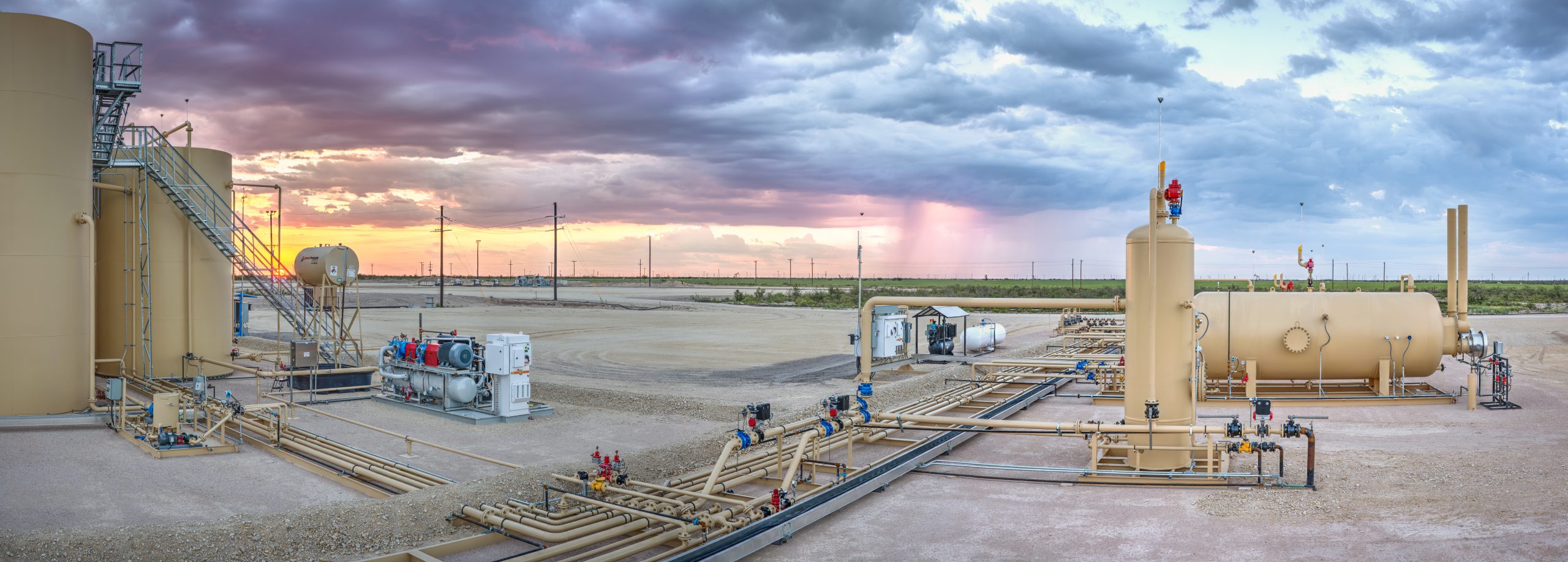
The company name Ro Flo is derived from the term “rotary.” A rotary vane compressor works well in H2S and other high-liquids applications.
Power on Demand
AB’s main offering is their ECOMAX® cogeneration system, a fully integrated, high-performance system. It’s based on an industrial gas engine driving an alternator that provides continuous power.
Kramp added, “The system is modular and plug-and-play, making installation fast and minimizing the on-site footprint. All critical components—including the engine, alternator, controls, and safety systems—are housed in a compact, single module. Advanced monitoring software enables remote performance tracking, load management, and predictive maintenance, ensuring maximum uptime and operational reliability.”
As the world’s most producing oil basin, it’s no surprise that companies here are in demand across the world, and global companies are looking to operate in this market as well.

Paul Wiseman
A longtime contributor to PB Oil and Gas Magazine, Paul Wiseman is an energy industry freelance writer.