The Huddleston family made national news recently when they turned down about $26 million to sell their Mason County, Kentucky farm to an AI company. Instead, they opted to preserve the family heritage of farming green plants instead of power plants and data centers.
State legislators in Alabama, Georgia, and elsewhere have declared moratoria on building more wind and solar farms to power data centers. Yards in many towns sport signs saying, “Say No to Data Centers.”
A Gallup poll released in May said that seven in 10 Americans oppose the construction of data centers for artificial intelligence in their local area—and 48 percent of those are “strongly opposed.”
DataCenterWatch.com reports that, overall, more than $64 billion worth of data center projects have been blocked or delayed in the last two years due to concerns about land use, power demand, water requirements, and more.
Meanwhile, back at the Permian Basin ranches, data centers are singing “Give me land, lots of land, under starry skies above,” and are being greatly rewarded.

People everywhere are concerned about adding more power demand to already-overloaded grids, including in the Permian. However, the solution here lies in tapping the plentiful amounts of wellhead or nearby pipeline natural gas coming from Permian wells to generate behind-the-meter electricity.
And the challenges faced by data center planners in many places regarding encroachment on nearby towns and cities are less of a problem in West Texas as well. Here, they’re building on land whose surface is largely unproductive agriculturally, inhabited only by small insects, reptiles, and mesquite.
This brings up several questions. How big could the Permian’s data center rush get? And yes, land and gas are plentiful—but what about water and connectivity to the communications grid? And finally, what kind of equipment is needed to turn the gas into power?
How Much Gas?
At energy analytics firm East Daley, they are looking at 76 MMcf of natural gas demand per day in seven projects currently in service. On the longer timeline, “We’re looking at about 1.9 billion cubic feet [Bcf] a day of total adjusted gas demand across 38 projects in 16 counties, which is our Permian regional definition,” said Oren Pilant, Energy Analyst for East Daley. That area includes Permian counties in Texas and New Mexico.
Total estimated electricity load would come to about 22 gigawatts (GW).
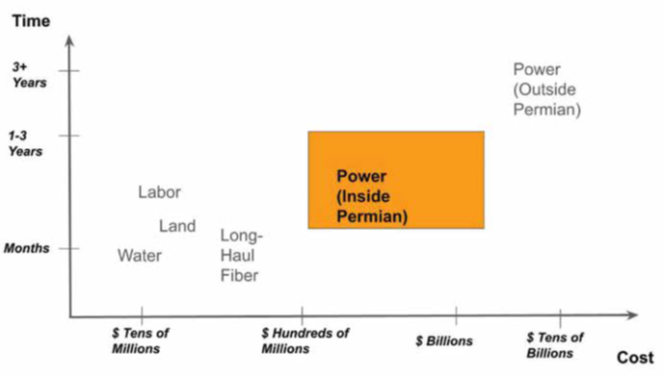
This graph from Baker Institute plots AI infastructure bottleneck factors against estimated time and cost to address.
A Source is a Source
This early in the game for the 31 in-process projects it’s hard to predict how much supply will be wellhead gas vs. pipeline, but Pilant says pipeline gas is likely to be the main source. Most current projects are at a distance from the main gas regions of the Permian, so pipelines would be the better option there.
“I think it’ll be a mix of longer haul pipelines like Atmos, West Texas gas transmission, and then a good share from the public service company in New Mexico [among others],” he said.
A notable exception could be in Lea County, N.M. A planned data center there “is probably the single largest facility in the broader Permian, which is right in that northern Delaware, which I think would be a good place to test how you can really plug into wellhead gas.”
Two main challenges with wellhead gas: (1), having a consistent gas supply when only a few wells are involved, and (2) the quality of the unprocessed natural gas. Nitrogen content (nitrogen reduces BTUs, or amount of heat, among other issues), and other impurities, especially hydrogen sulfide, which is corrosive and poisonous, could reduce efficiency or damage equipment.
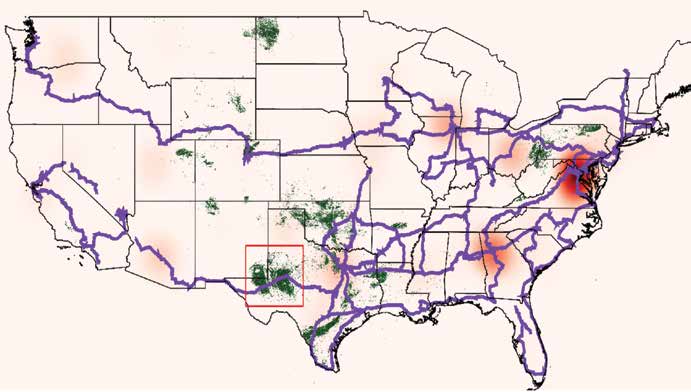
What this map shows: Exiting/under construction/announced data center concentrations (Red = most datacenter megawatts in heatmap), selected trunk fiber routes (purple), and oil and gas wells (dark green). What it means: The Permian has major upside for AI development.
Waha Negativity Relief
Producers struggle with the fact that natural gas prices at the benchmark Waha hub have averaged around -$4 per MMBtu for most of the spring, Pilant said. In mid-May, prices had risen somewhat to -$1.63/MMBtu. Producers do still profit from just the oil, but it would help their bottom line to at least not have to pay to have the gas go into the pipeline.
Any option to sell that gas to behind-the-meter data center power plants at positive numbers appeals to many producers.
Data center planners have taken note of those low Waha prices, Pilant said. “Permian gas is very cheap relative to other basins, which is why producers or data center developers would say, hey, we can go get cheap gas in the Permian.”
On the flip side, data centers are far from being the only hope for gas profits, Pilant pointed out, saying, “You’ve got 5 Bcf a day coming online later this year. And through 2030, there’s going to be over 11 Bcf a day total of new egress capacity. That will have the largest impact on strengthening Waha in the future, but there are certain periods of the forecast where we do see egress getting tight again, [such as] late-to-mid 2027.”

Also from the Baker institute: Permian Basin installed electricity generation base, in megawatts.

Can This Get Too Big?
And then the conundrum: What if things flip, so that all the new pipelines and data centers eventually exceed Permian gas output? In that case, said Pilant, the cheap-gas-paradigm-for-data-centers dynamic goes out the window, and it could “raise the price of a Permian molecule.”
Of course, competition for gas isn’t just from other data centers. As Rice University’s Baker Institute for Public Policy points out, “Datacenters won’t have a monopoly on gas supplies—rather, they will have to compete with LNG exports, petrochemicals, and other gas users. It is important to acknowledge this reality.” That is from a paper entitled, “Could the Permian Basin Become America’s Next AI Data Hub?” by Gabriel Collins, J.D.
Beauchamp: Boosting Development is a “Win-Win”
Midland-Odessa Transportation Alliance (MOTRAN) President James Beauchamp has worked on this issue for years. He noted that, while pipelines are indeed being built, “We have seen significant increases in natural gas production beyond capacity improvements.
“Data centers located in the Permian form a symbiotic relationship with producers by using abundant and often underpriced natural gas to generate shared power with those producers, which is actually easing grid concerns in our area where there has been little to no investment in the grid.”
He also sees too little grid investment planned to keep up with growth, so “we view this ability to use a local commodity [natural gas] to provide power for the new data centers [increasing the local property tax base] who in our case are mostly reducing grid demand by sharing power generation with energy producers as a win-win.”
Data Pipeline Latency Solved
One Permian advantage rarely discussed involves data communication delays, or “latency.” In what’s known as “Data Center Alley” in eastern Virginia near Washington, D.C., where 70 percent of global data traffic flows, with over 100 hyperscale data facilities and more than 600 of all types, data latency is a significant issue, Pilant pointed out. Basically, Data Center Alley has the same pipeline issues as the Permian, only with data instead of natural gas.
In the Permian, cables might have to be run to connect with new projects, but the concentration would have to go a long way to reach the bottlenecks seen in Virginia. Besides, said Pilant, “Developers have realized that it’s much easier to lay fiber versus new pipelines.”
Water issues
Data center cooling procedures are very thirsty, Collins’s paper points out. While exact water use depends on the cooling type, “In a high-water-usage case, the largest AI-focused data centers could each potentially require 5- to-6 million gallons of water per day.”
In perspective, 6 million gallons is about 143 thousand barrels per day—about “the average water demand of a 10-rig drilling and completion program.” He suggests a move toward air cooling—which in the Permian’s hot summers might require even more natural gas to power the cooling equipment.
Caterpillar Turns Molecules into Megawatts
It’s no wonder natural gas generation is a key part of data center operations, said Chris Berrie, Caterpillar Inc. Senior Sales Manager, Gas Compression and Exploration and Production Services. As Caterpillar had been supplying the oil and gas industry with reliable site-based power for decades already, due to issues with the grid availability in the Permian, they’ve seen the challenges up close.
“As we look to some of the solutions that we’ve been engaged with, gas power generation is front and center” for both oil and gas and data center customers, he observed.
The rapid growth of data centers in West Texas has already been “a major driver of increased power demand,” he said. With demand greatly outpacing supply, it’s led to load shortages across the Basin, and for that there’s no end in sight.
Berrie quoted figures from the Energy Reliability Council of Texas (ERCOT), predicting demand for the ERCOT grid growth to be around 150 Gigawatts (GW) by 2030, with around 15 GW expected to support demand in the Permian Basin. Data centers will be responsible for a significant amount of that. It can currently take three years or more to get new grid connections, he noted.
Long Term Solution
This is pushing both data centers and energy producers to look to companies like Caterpillar to provide solutions for gas power generation—not just as a bridge, but as a long-term solution. Said Berrie, “Our mission is solving our customers’ toughest challenges. We like to lean in and understand what challenges and problems they’re seeing and work to develop solutions to support.”
Building gas-powered microgrids for remote sites is a key part of Caterpillar’s work. “Microgrids are also a very viable option for sites that have high loads and access to natural gas. Working with our customers we’ve implemented many microgrids utilizing natural gas gensets, and gas turbines from our Solar Turbines division. These microgrids can be tied to the grid, behind the meter, or in island mode,” Berrie said.
Key options, he said, include Caterpillar’s G3520, G3516, as well as their Solar Turbines division.
Gas Flexibility
In the case of wellhead gas, the generation equipment must be optimized to the particular supply because, “Gas is not always created equal.” Variations in gas composition including heavy hydrocarbons such as natural gas liquids (NGLs) allow us to work with our customers and provide solutions optimized for the gas at site,” he pointed out.
“We design equipment to run on a variety of gas compositions,” he said. And sometimes it might also make best economic sense to have onsite equipment to remove some of those heavy hydrocarbons, because NGLs can be of great value to customers.
When asked if the company makes designs specifically for data centers, Berrie noted that they develop solutions for a variety of industries, applying and updating technology to meet many different needs, including data centers and other large-load sites.
Permian’s Power
He sees the Permian’s abundance of natural gas, including “flare gas, associated gas, invasive gas,” as “a great energy source.” In the case of captured gas, using it for data centers can reduce wasted emissions, relieve grid strain, and thereby be more reliable than the grid.
“Natural gas power is a great resource to do that. At least in the near term… it is by far the best resource.”
As Beauchamp said, “It’s a win-win.”

Paul Wiseman
A longtime contributor to PB Oil and Gas Magazine, Paul Wiseman is an energy industry freelance writer.