









Click here to listen to the Audio version of this story!
What if you could ask your smart speaker something like, “Hey, for our wells in Loving County, what is the risk of frac hits from neighboring leases?” and, in a few seconds, get a detailed answer?
Although this sounds amazingly close to asking Alexa to play the Beatles’ greatest hits (not their frac hits), AI is making this and similar requests a very insightful reality. Its ability to digest, summarize, and interpret millions of data points in minutes instead of the weeks required for humans to do that is changing the landscape for Permian operators.
In fact, the claims for AI are often broad and indefinite:
Save massive amounts of time!

Slash your overhead!
Reduce breakeven costs!
In compiling this report we looked for real-world situations for AI and how it can actually help in the oil patch. The quote above—greatly paraphrased from an example—came from SynMax’s BasinIQ system. Our report also includes a look at Percepto’s drone-acquired data for wellsite monitoring, and how Chevron leverages AI to increase production.

Chevron’s proprietary Automated Production Outlook and Location Optimization system, dubbed APOLO for short, helps teams by showing how changes in spacing, proppant, and fluid use may affect production. And the AI-based system learns over time.
Ask Atlas for BasinIQ to Help Dodge a Frac Hit
Instead of “Alexa,” SynMax’s moniker for its BasinIQ product is “Atlas.” The predecessor for BasinIQ was called “Hyperion,” a Greek deity. Atlas, of course, was also a Greek god. But Atlas also invokes a classic name for maps, which is more to the point.
SynMax’s Director of Technology Rahul Verma said that Hyperion began in 2021 as a tool for industry investors to get early eyes on new oilfield activity.
Compiling data from large, high-resolution photos of all oil and gas activity in the United States and Canada, they created a database. “Based on those pictures, we are making forecasts of what is going to happen in the energy markets in the next few months, so energy traders can speculate on that information.”
In the process, Verma said, the developers noticed those photos included a lot of other data. “For example, level production data, pipeline data sets, geology, completion reports, permits, in addition to all of the satellite imaging that we’ve been doing.”
Next, after some market discovery, they realized they could expand its functionality and grow its market. As a result, “BasinIQ is our further refinement of that offering, now for operators, for landmen, landowners, and also some other enterprise use cases.” He said the latter was more about AI application than data gathering.
Verma sees in this new business model a bigger picture: accelerating real innovation in the oil and gas industry. For all AI’s results elsewhere, “a lot of that has not really affected how things work in oil and gas,” at least in part because, “the speed of adoption is just not there.”
BasinIQ is geared toward smaller users who he sees as hungry to get ahead, to differentiate themselves, possibly more driven to improve their bottom line than the bigger companies.
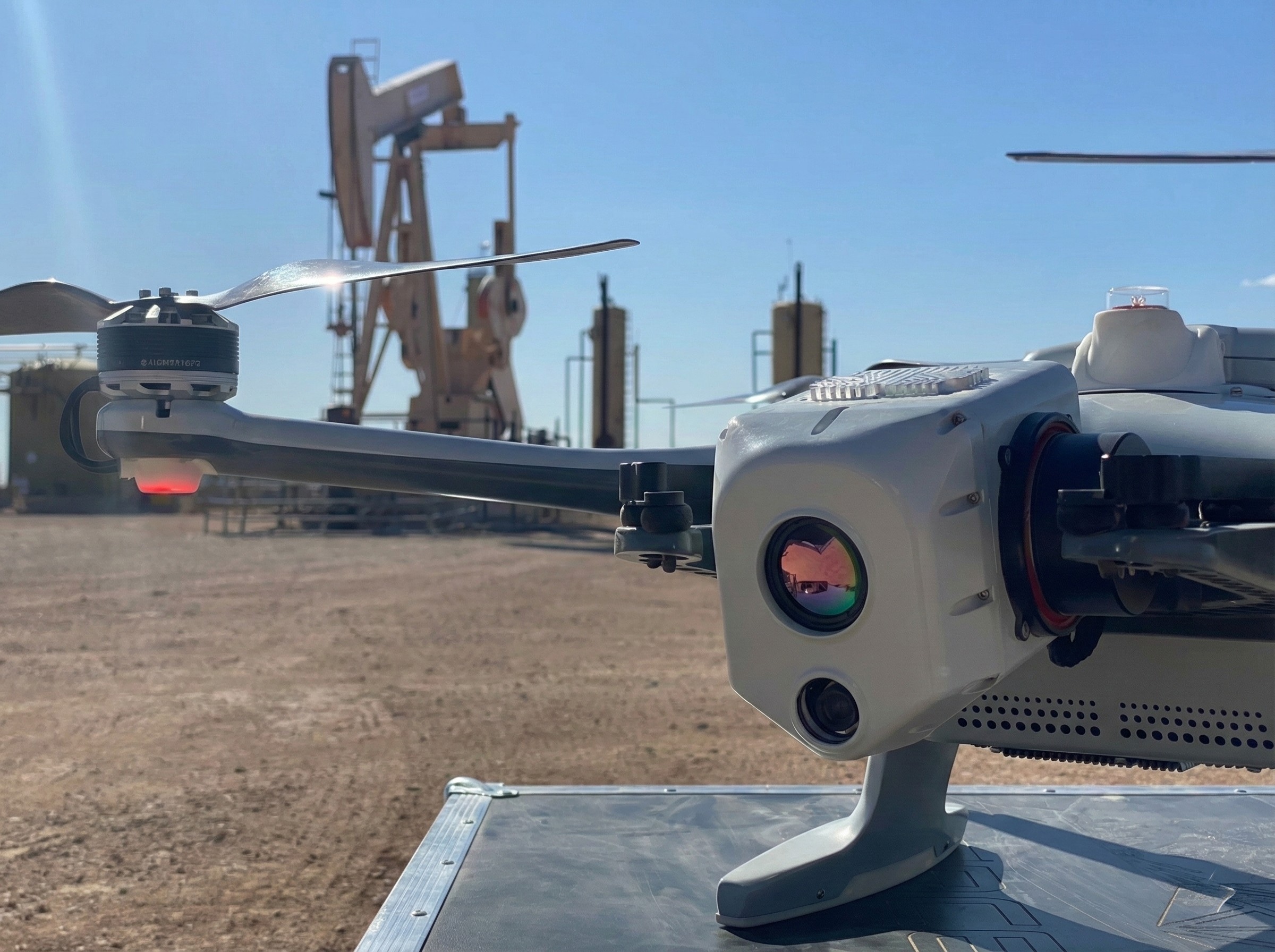
Percepto’s Air Max OGI drone, with onboard AI, flags emissions in real time.
Bring Your Own Data
Verma was among the writers of the case study entitled “From Loss to Leverage: Quantifying Frac Hit Risk and Proactively Protecting Wellbore Assets with BasinIQ.” He said that was an example of “bring your own data.”
He quickly explained that BasinIQ does leverage SynMax’s satellite data but for this job, “you would need to tie in our agentic AI solution and satellite images with data they are seeing at the wellhead, like SCADA data or daily level production data.”
Verma outlined a typical query for the system in that case as, “Can you tell me, is there a leak on site? Is there an anomaly in that production line?”
Or as the company’s white paper words the request, “Let’s consider a frac hit to be when a new well is drilled within 500 feet of another well. Create a database of all the frac hits in Permian New Mexico and show me the results.”

Rahul Verma
Summarizing the answer, the white paper said, “The analysis showed that 441 out of 4,058 wells within New Mexico’s portion of the Permian Basin currently qualify under this definition.”
Although the impact of a frac hit can in odd cases be beneficial, it usually negatively affects the existing well’s production and operation, he said. Operators may avoid this on their own leases with proper use of their internal data, but wells near the edge may be subject to a hit from another operator.
In either case, BasinIQ can warn operators of the need to take appropriate action. “We don’t tell them what to do,” he said, as SynMax leaves the exact resolution to the operator’s discretion.
Time efficiency is its main benefit, Verma noted. The system is sorting “very, very, very noisy data” in which “even getting started on making analysis is pretty hard” without AI help.
Its design is simply to help humans: experts will always be needed for the actual analysis. “You would always need that expert in the loop, but the AI can accelerate their work. Instead of them having to look at five data streams, they can monitor more like 100 of them,” he said. Doing so gives one a much broader and clearer view of the situation.
Percepto’s “Drone-in-a-Box” Reduces Travel Mileage
Why send a human—or a series of humans—to check on a distant well’s leak if launching an onsite sensor-equipped drone can report on the situation in a few minutes?
That’s the concept behind Percepto’s “Drone-in-a-Box” system. It’s used by Chevron to reduce some of the one-million yearly miles put on by field people driving to and from well sites.
For Chevron, the top priority is safety: fewer miles driven means fewer opportunities for an accident. After that, the priorities are to do it cleanly, then to make money in the process. Percepto’s AI-informed drones help with all three.
What’s Different About These Drones?
In an email interview response, Percepto’s Udi Zohar, Chief Product Officer, said, “These [drones’ AI systems] are continually trained to understand if the emission is within tolerance or not. For instance, is the flare combusting at 98 percent efficiency?” For any such attention-requiring occurrence, the system alerts the proper personnel.

Udi Zohar
It’s for more than just emissions. “We have a suite of additional use case and mission types that can be flown depending on customer needs. AI-powered use cases include liquid leak detection and power pole inspection [thermal and RGB anomaly detection across electric distribution infrastructure],” they said.
Drones have been taking RGB (visual) photos, LDAR (leak detection and repair) photos, and others for many years—and that’s been very helpful. To take that further, Percepto has trained AI to pinpoint leaks down to the exact valve, to differentiate between fugitive emissions (that need repair) and non-fugitive emissions (flares, compressor exhausts, etc.).
Drones can be scheduled for regular flyovers using OGI (optical gas imaging) technology and employing Percepto’s AIM software to detect changes. Inspection can also be triggered by anomalous readings from inline sensors. “If the customer sees an alert from a pressure/temperature sensor, or from a fixed gas detection sensor, they can immediately request a mission over that asset from their Percepto system and have live video feed within an hour [often quicker].”
After that, “The control room can then inform the field team of the exact issue so they can arrive with the right tools/equipment to solve it in a single visit.”
Chevron’s Percepto Use
At a recent Energy Drone and Robotics Summit in The Woodlands, Chevron’s Midland-based Operations Superintendent Kerri Harvey and Katherine Snyder, operations digital advisor, along with Percepto’s Sam Jones, discussed how Drone-in-a-Box saves the company thousands of travel miles while giving them current data.
For perspective, Harvey explained that visiting every Permian asset once a year would involve “50,000 inspections, 40 people, 20 trucks.” Of course, that wide an interval is not realistic, but multiplying that by 365 seems equally unrealistic in time, equipment, fuel, and safety.
Instead, Percepto drones regularly inspect sites, providing real-time data. With that they can easily compare data between flights, noting changes and anomalies that let them head off larger issues.
Combined with that is an AI-based emissions detector. Trained in hundreds of thousands of cases to identify issues, it eliminates the need for people to park in front of computer screens for hours every day to identify the occasional issue.
Snyder verified the system’s profit benefits. “For us, what this meant was not only doing it at scale with more activity and more people, but also chasing that cash margin.” She later noted the safety issue of the reduction of thousands of road miles.
Surprisingly, the employees liked it, said Snyder. Upon learning how Chevron’s Integrated Operations Center (IOC, which monitors field sensor data) can launch the drone to clarify the situation, one longtime field employee asked, “You mean when the IOC sees something wrong, they can just launch the drone instead of me having to run out there?” When Snyder answered in the affirmative, the field guy exclaimed, “Well thank God!”
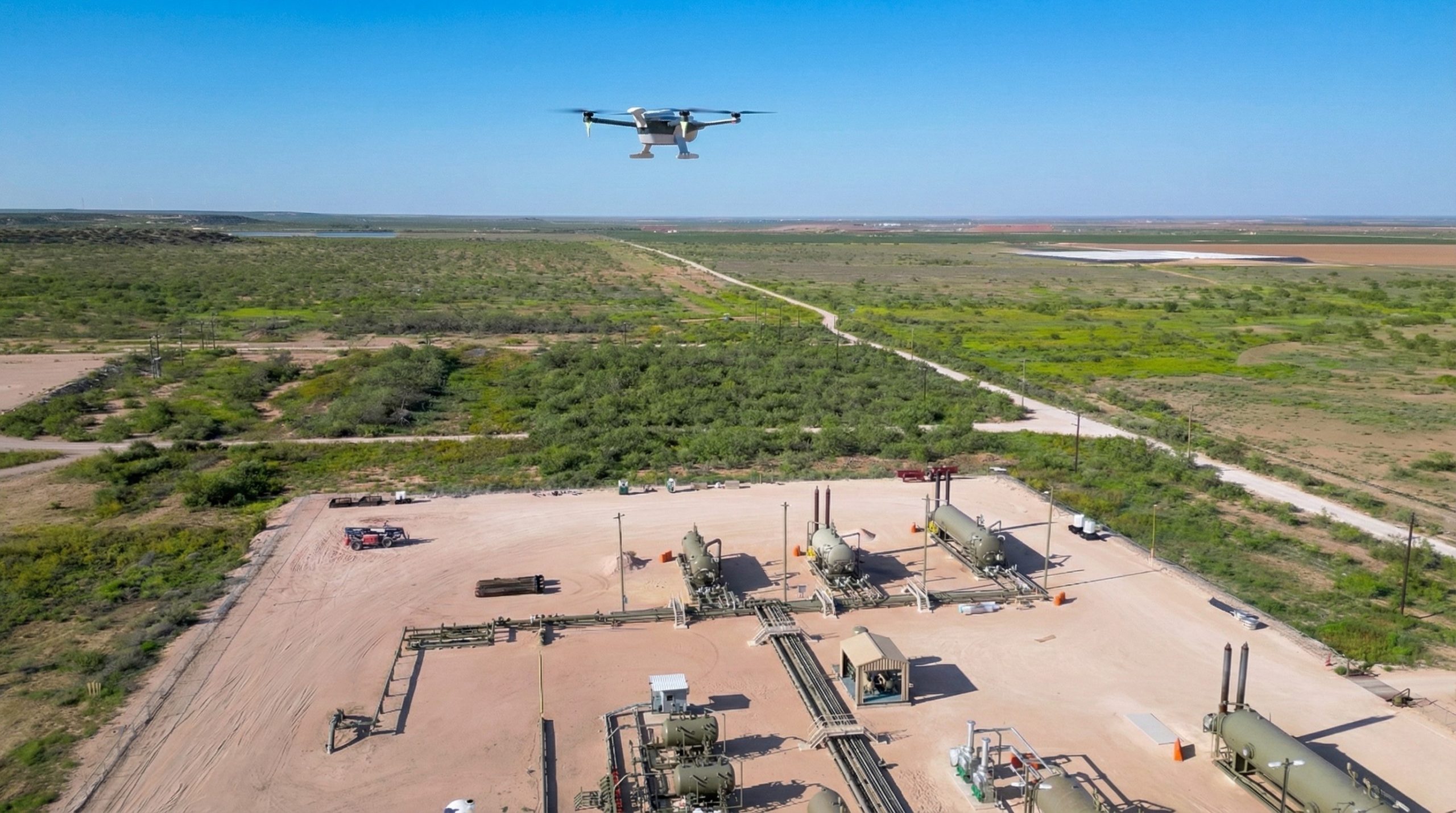
A Percepto OGI drone hovers over a Chevron pad.
AI Also Helps Chevron Explore the Permian
Drones are only one aspect of Chevron’s AI interaction. Their proprietary APOLO system helps efficiently find and produce oil. Here, the similarity to another Greek god is not connected with SynMax’s naming system.
An acronym for “Automated Production Outlook and Location Optimization,” APOLO uses AI to analyze numerous subsurface variables among thousands of wells to deliver forecasts that are both clear and accurate. It helps engineers tailor decisions on individual wells instead of using a one-size-fits-all approach.
A Chevron release on the topic says, “It shows how changes in spacing, proppant. and fluid use may affect production. And it learns over time, so it can simulate different designs in different spots—aiming to make future development faster and more accurate.”
In the Permian and DJ basins, APOLO helps teams predict a well’s performance from the start. Standardization, speed, and increased accuracy of forecasts.
The Bottom Line
Safety and the bottom line are among the top motivators for using AI in any industry, including oil and gas. As seen here, companies large and small are finding ways to leverage AI’s immense data management capabilities to inform decisions, reduce what’s called “windshield time,” and, basically, improve safety and profits.

Paul Wiseman
A longtime contributor to PB Oil and Gas Magazine, Paul Wiseman is an energy industry freelance writer.