







Back to Reality. We have transitioned in the past 12 to 18 months from “oil and gas” to “energy, power, and electricity.” We didn’t know what data centers were a couple of years ago, and now there is little else that seems to matter. We are still waiting to see if it is a bubble, a boom, or the latest shiny object. There is more to the world than data centers, but if you read the news, you might have trouble believing that sentiment. There is only one big missing gap in the electricity market, and that is electric vehicles. Here, fossil fuels continue to hold sway, helped by $2.19 gasoline at Costco and the dramatic slowing of interest for vehicles that run on electrons.
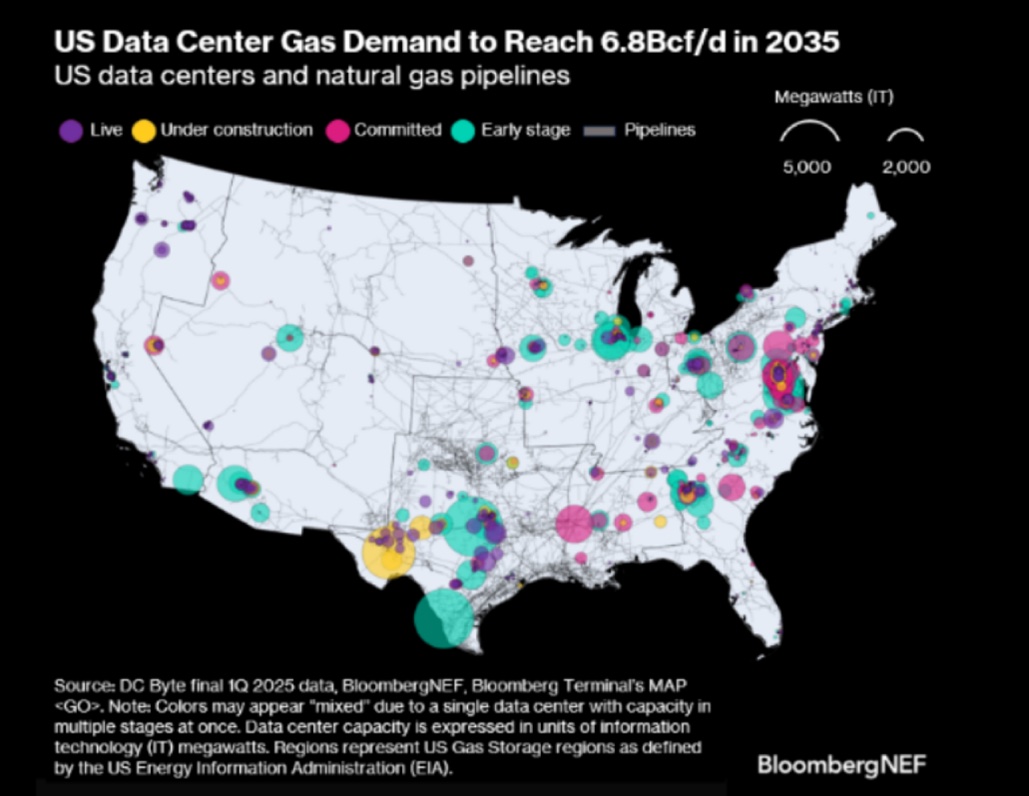
Current and Future. Currently, we use about 1.3Bcf per day for the data centers we have up and running. Most are in Virginia and they provide the “cloud” as we know it. (See accompanying chart showing map of U.S.) According to BloombergNEF and others, that demand will hit 6.8 Bcf per day in 2035.
Another Opinion. Wood Mackenzie put out their theme for oil and gas for 2026. There are no great revelations. Most analysts expect a 3-4 percent decline in spending and rig counts and that may even be optimistic. “Oil-focused regions will face price headwinds and see less activity. Liquids production will fall versus 2025. But gas-focused regions are positioned for growth.” “Lower 48 oil production will stall in 2026 for the first time since the pandemic.” “Delaware Wolfcamp oil will plateau for the first time post-pandemic, but associated gas production from the play will top 10 Bcf per day in 2026. Rising gas-oil-ratios and development shifting to gassier areas of the basin drive gas volume growth.” “Motivated buyers will bid up U.S. gas assets with a firm floor of $4/Mcf long term price.” “LNG project developers face a critical supply chain challenge that will reshape U.S. gas investment priorities.” “Permian gas alone cannot meet growing export demand.” Rystad said that the priority areas where digitalization can deliver the largest near-term gains are drilling optimization, autonomous robotics, predictive maintenance, reservoir management, and logistics optimization. (See related chart.) Together, these technologies could reshape cost structures for operators and oilfield service companies as they contend with shifting market conditions and tighter capital discipline.

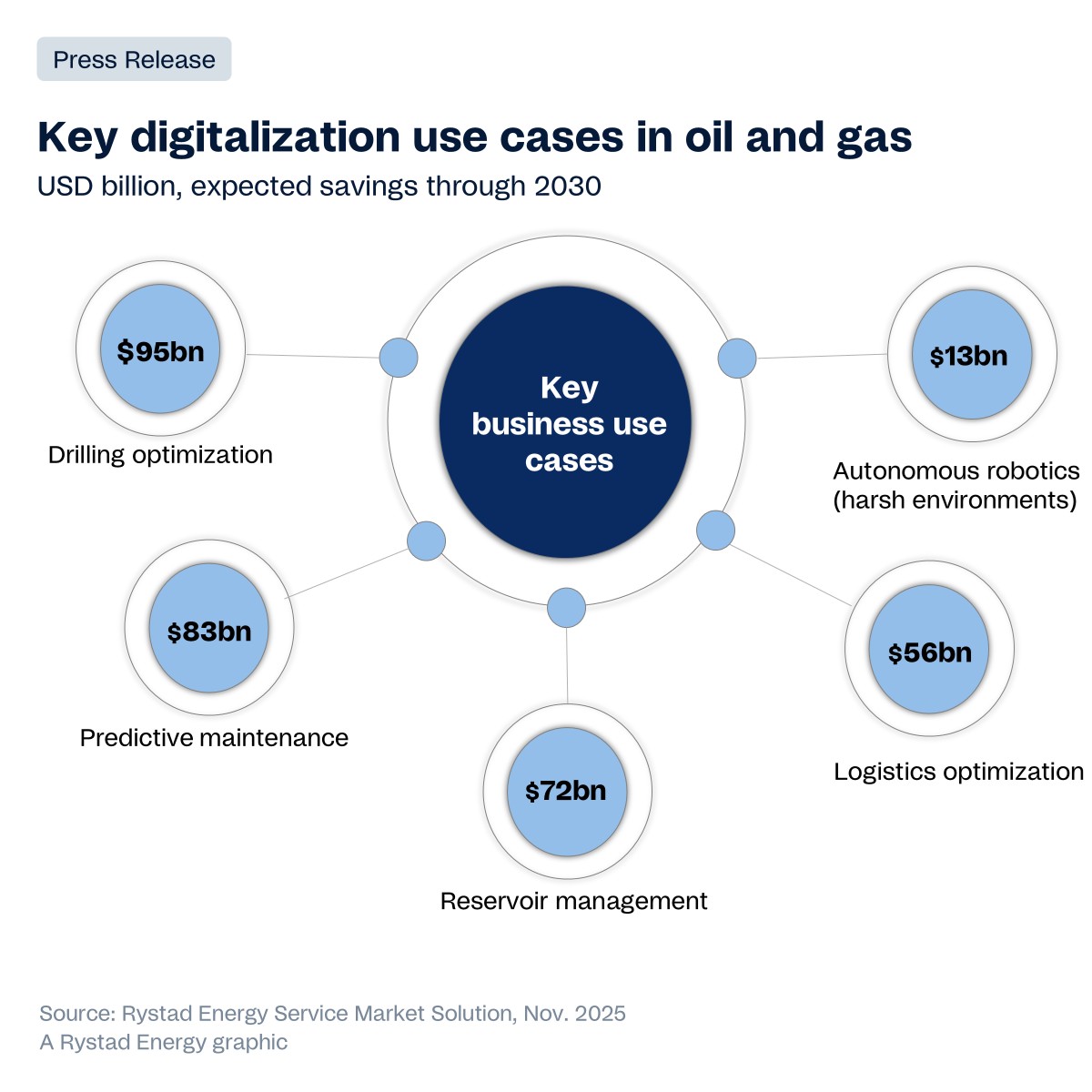

Strap In. We have written about how AI is going to improve and change our lives and our industry much more than currently expected and much quicker than conventional wisdom. Consulting firms have significant issues, as do accountants, lawyers, geophysicists, and others. Work can be done much more quickly and, given enough data, can be much more accurate than currently understood. Chevron has an ad out that talks about its internal AI agent, which has all the relevant data to project better recoveries. HP claims it is accelerating its AI efforts, which include the layoffs of 9,000 people. Now Rystad is saying that the oil and gas industry could capture more than $320 billion in savings over the next five years by accelerating digital adoption across core operational domains. The findings underscore how digital technologies, once considered optional enhancements, are rapidly becoming essential tools for efficiency, resilience, and long-term competitiveness.
 Subscribe to Jim Wicklund’s full e-newsletter, “Things I Learned This Week at…,” distributed weekly via email, by signing up for free at this webpage: https://www.pphb.com/newsletters. Jim is Managing Director / Client Relations and Business Development for investment banking firm PPHB. Leveraging deep industry knowledge and experience, Houston-based PPHB has advised on more than 180 transactions exceeding $11 Billion in total value. PPHB advises in mergers & acquisitions, both sell-side and buy-side, raises institutional private equity and debt, and offers debt and restructuring advisory services. The firm provides clients with proven investment banking partners, committed to the industry, and committed to success.