It wasn’t that long ago that the number of data points for rigs and oilfield equipment could be counted on the fingers of one hand: Is it on, is it leaking, does it sound like it’s working right? All could only be gathered in person—and that last one could be up for discussion.
Even a few years ago datapoints, gathered remotely, numbered just a few dozen, then a few hundred, now it’s more than a thousand and growing. Consolidating, analyzing, and acting on those datapoints is the bailiwick of today’s cutting-edge computer and, yes, AI systems.
Here we learn more about two of them. Patterson-UTI (NASDAC: PTEN) and their new (2023) merger partner, NexTier, with their PTEN™ Digital Performance Center (DPC), an AI-enabled, centralized logistics system for drilling, completions, and more; and SitePro Edge, which lets operators monitor diverse equipment without an IPC onsite, economizing monitoring for remote or challenging locations.
Technology-Enabled, Not Just Hardware Any More




Scott McKee
“We tend to think of ourselves more and more as a technology-enabled service provider. we don’t just provide equipment and people, but obviously a lot of data that comes out of every stage of drilling and completions from end to end,” said Scott McKee, Patterson-UTI Senior VP of Marketing and Business Development. He leads the company’s global commercial growth strategy, integrating marketing, business development, and customer insights to support technology-driven solutions across its business lines.
Technology has upped the game, he said. “I don’t think drilling [itself] has changed a lot, and if we were at some point in history playing checkers, now we’re playing chess and beyond,” he said. Maybe even 3-D chess.
What It Does
In those early days of a handful of datapoints, there was also a lot of siloing—in desktop computers, file cabinets, and in the drilling manager’s head. “As recently as 2020 we had a few hundred data channels per rig. Today, it’s about 1,200 channels per rig and growing,” McKee observed.
The Digital Performance Center’s purpose is to connect those siloed and massive data streams and workflows to keep everyone on the same page, “across the entire wellsite,” says the NextTier website. It’s connecting hydraulic fracturing, wireline, fuel, and others in one place.
Ultimately, the goal is to increase efficiency and reduce costs. The site adds, “Compared to self-managed logistics, NexTier customers leveraging PTEN digital solutions have reduced average wellsite wait times by up to 96 percent.”
Here’s how McKee puts it: “If you can measure something, then you can hold it accountable. And that’s what we’re really trying to do, is put it all together.”
How Does It Work?
With many of today’s monitoring systems, the question involves who’s doing the human interaction, either for alarms or for viewing the workflow. For PTEN, it’s a mix, McKee said, calling it “a hybrid model.”
Customers have full, real-time access to their data through the PTEN Plus platform, but PTEN engineers are also eyeballing it, “actively collaborating with them, developing custom alerts as needed, doing support initiatives.”
Allowing PTEN’s SMEs to give input lets the operator concentrate on their own issues, leaving the expertise of the drilling itself to the experts in that field, PTEN. That way, “We can focus on our equipment and our operations, and the operator can focus on real-time treatment execution, which is what they care about.”
Overall, here’s the workflow, according to McKee: “The performance center gets some data, they decide they need to make some adjustments, and within a minute or less, those adjustments are made in the field. And that’s amazing.”
Predictive Maintenance
In the digital age the industry has gone from preventive maintenance, like an oil change in a car, where things were done on a regular and arbitrary schedule, to predictive maintenance, where service needs are detected and done as they are actually needed.
McKee explained, “If you have more information coming in, you can do predictive failure [analysis]. You can take things offline proactively and not really disrupt the operation.”
He continued, “You find out in the past, when something did go down, what were the indicators leading up to it? And you plan differently operationally around that.”
Specifically, “We’ve been able to eliminate recurring wireline failures, avoiding 8 to 10 hours of downtime per pad. We’ve improved pump downstage efficiency in roughly 50 percent of targeted applications.”
The PTEN Digital Performance Center is at the foundation of Patterson-UTI’s operations. A dedicated team monitors real-time data and analytics, reports, and automated alerts for the entire rig fleet. Photo: Patterson-UTI
Just When You Think It Couldn’t Get Any Better
Even the best operations, no matter how good, can benefit from this information. “I’ve been to many a meeting with an operator where you think things couldn’t go any better. And they’re like, hey, we’ve got to get some of this NPT [non-productive time] out of the equation. And you’re thinking, what are you talking about? Then inevitably, six months later, you’ve shaved many days off the well.” That is, off that well that you thought was already running at maximum efficiency.
Results in the Field
On the drilling side, “We’re generally seeing more wells, more footage drilled, better wellbore placement, fewer rigs doing it, and fewer days with better financials.”
On completions, “They’re able to pump more hours per day, which delivers a total cost-per-well reduction.”
Many drillers have felt they were greatly challenged in keeping up with everything on the site, he said, so they generally don’t feel threatened by the digital system. In fact, said McKee, most have bought into the idea that “they’re not trying to replace me, they’re basically trying to help me.”
SitePro Removes Siloes, Makes Small Monitoring Affordable

David Bateman
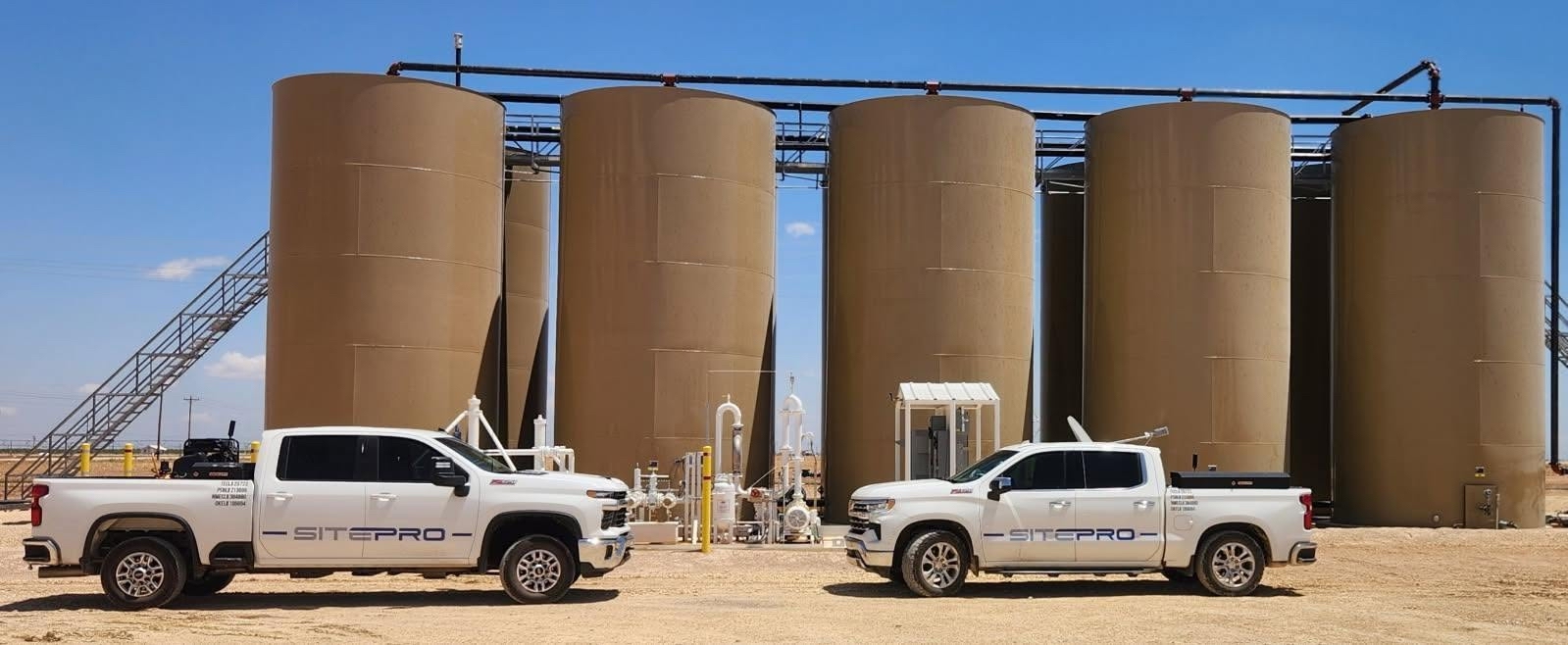
Speaking of siloing, SitePro’s Chairman and CEO David Bateman and Chief Technology Officer (CTO) Dustin Brown are excited about how SitePro Edge connects disparate systems, old and new, into one place. And it also is cost-friendly enough to allow monitoring of small and distant sites that have until now been left in the dark.
Bateman noted that in recent years the development of software solutions for specific problems, including “drilling, completions, production, SCADA, accounting, back office, analytics” has skyrocketed.
There’s also the AI revolution. In light of that, Bateman noted that Brown and his team took a disciplined approach to achieving their next step.
SitePro historically has used software loaded into edge computers, called IPCs or “industrial personal computers” for site control and monitoring. “And most of the jobs that we did with that required custom quoting, project management, implementation, installation, to get things up and running,” Bateman recalled.
Now their future looks to be in gathering data from disparate systems “where the end user really has one platform or one point of contact. It’s called an open API [application programming interface] framework, where we can basically push or pull/push our data into another system or pull data from another system into SitePro and create that seamless software experience for the customer.”
With Edge, they created something that went beyond site-specific schedules. Said Bateman, “It’s a lower-cost device that can work in a variety of applications. And most importantly, it can be stocked on shelves and resold by channel partners.” Even more, it can be installed by “somebody that doesn’t have a technical background.”
This way, users can use their existing systems that have served them well in recent years, without needing the expense and inconvenience of a major upgrade. In answer to a question, he was definite that there is nothing of what’s known as “planned obsolescence” in this system.
Calling it “the first intelligent automation platform in the space,” Brown said the system fabrics together various levels of devices “that can run an entire platform.”
He summed it up as, “I’d say the edge becomes the operational brain sitting between the field equipment and enterprise systems.”
In the Beginning
Dustin Brown
The first step, its current status, is to gather disparate data into one place and enable the sending of alarms. Instead of running to one platform for drilling, one for completions, a different one for accounting, and another for logistics—clients can consolidate what they already have into SitePro Edge.
Brown explained, “We’re adding the remote control as we speak right now, which will handle some of the automation logic and provide interfaces for other devices and future partners. We’re working with some really good industry leaders right now that are coming up with some really awesome field devices that embrace AI.”
Those are being deployed next to edge devices, using AI workloads to sort the data.
When that’s done, “Now we can manage fleets of thousands of these devices with ease and have fine-grained control over the modules that live within each one of those,” said Brown.
While this does move beyond the IPCs that are already installed, Brown stressed that everything a client already has will still work. “You’re not going to have to get rid of the current way that you interact with SitePro. We’re just evolving it into a more capable system.”
In fact, “In the Permian for operators, they’re not looking for new sensors. They’re looking for a way to make sense of all this data that comes in and make it actionable. The key with the alarms being the first major standalone feature with the Edge is that it gives us the right signals so that we can start to operate around some of the alerts and inputs that we’re seeing in the field,” Brown said.
Affordability Expands the Market
Bateman talked about the economics, in which operators were always fine with using an advanced monitoring and control system at a large facility. But small assets, necessary but distant and without regular power to run automation equipment, not so much. Updating the entire site to run a few sensors would not have much of a return on investment.
“Now with a lower cost point and lower compute demand, it’s a lot easier to do that. And it takes the economic hurdle out of the way,” Bateman said.
Brown said benefits could mainly be boiled down to miles—and hours—saved in making long trips for a technician to do one or two things. “That’s enabling people to do what they prioritize over needing to be out in the field, looking at an asset that simply could be enabled with the Edge OS and brought into the platform and have that visibility in your mobile app or your web application.”
Availability Also Expands the Market
Many systems like this are sold as a package along with a company’s services. Bateman and Brown are seeing this as a marketable option that could be open to any location and to many industries.
For their own clients, it’s moved the planning and adoption process from as much as several months to as little as 24 hours. Said Brown, “We’ve had some deals [with the Edge] get sold, commissioned, and turned on within a 24-hour period. That’s been unheard of for us.”
In Sum
Bateman sees a bright future for this as it continues to develop. “One of the big challenges has been, how do we put this technology at the edge without sacrificing the feature-rich aspects of what we’ve always been doing with site control? I think that the more we integrate that technology, it’s driven the cost down, the more speed at which that takes up.
“And frankly, I think that it’s got the potential to triple or even quadruple our site count in a short period of time.

Paul Wiseman
A longtime contributor to PB Oil and Gas Magazine, Paul Wiseman is an energy industry freelance writer.