








Click here to listen to the Audio version of this story!
It’s a new kind of truck on an old familiar road. If you’ve spent any time driving Interstate 20 through the Permian Basin, you know the rhythm of the road. Long stretches of asphalt. Pickups and hotshots. Endless convoys of sand trucks running east and west. Wheels in motion from Big Spring to Pecos, Jal to Midland-Odessa, and everywhere else in between in the Permian.
But lately, there’s something new moving through that familiar picture.
Along the I-20 corridor, and increasingly on state highways and private lease roads, autonomous trucks are beginning to share the road with traditional freight traffic. These aren’t concept vehicles or closed-track experiments. They are full-scale, Class 8 trucks hauling real loads, tied directly into the oilfield supply chain.
“The technology is here,” says James Beauchamp, President of the Midland-Odessa Transportation Alliance (MOTRAN). “Kodiak and Aurora are already running long-haul routes that pass through the Permian Basin. Kodiak even has a facility right here in Odessa.”

What once felt like a distant Silicon Valley idea is now a West Texas reality.
What’s Already Happening in the Basin
The Permian Basin has quietly become one of the most active proving grounds for autonomous trucking in the country.
Kodiak Robotics, one of the major players in the autonomous freight space, has established operations in Odessa and is already running autonomous trucks tied directly to oilfield logistics. According to Beauchamp, the company began with a small number of vehicles, about ten sand haulers, intentionally starting slow to move through the learning curve.
“They didn’t come in with hundreds of trucks,” he explained to me. “They started small, focused on frac sand, and built from there.”
Frac sand, of course, is the backbone of modern shale development. Millions of tons move into the Permian every year, feeding completions operations across hundreds of miles of lease roads and highways. Union Pacific alone moves approximately 40 percent of the frac sand that enters the Permian Basin, with additional volumes coming from places like the Powder River Basin in Wyoming.
But trucking remains the last, and often most expensive, leg of the journey.
“There’s so much competition in frac sand today, even with consolidation in the industry,” Beauchamp says. “Margins are tight. Everyone is under pressure to cut costs and deliver efficiencies.” That economic pressure is one of the main reasons autonomous trucking is gaining traction now.
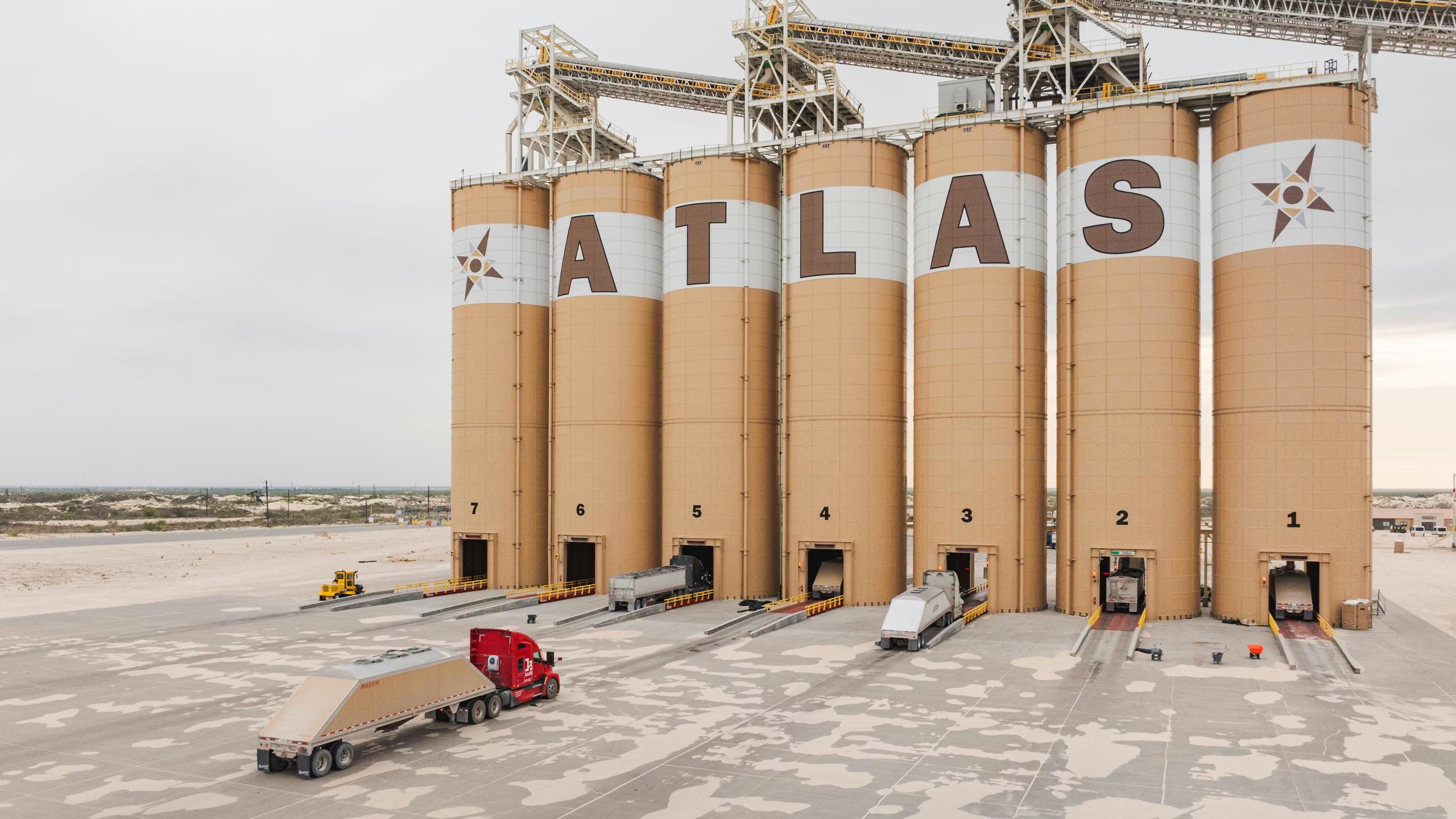
If there is such a thing as the perfect oilfield task for automated trucking, sand hauling might be it. Here, a Kodiak truck queues up at Atlas Sand’s silos.
The Basin’s Unique Role—And How It Compares Nationally
Across the United States, autonomous trucking companies are targeting long, predictable freight corridors: Texas triangle routes, Southwestern interstates, and major logistics hubs. Aurora, for example, has been operating autonomous routes between Dallas and Houston and, by the end of 2025, entered a contract with Detmar Logistics to move into autonomous deliveries along Texas state highways tied to energy supply chains.
But the Permian Basin offers something few other regions can.
“About one-third of all freight in Texas comes into the Permian,” Beauchamp notes. “Traditional cargo flows from the Gulf, Houston, Corpus, Dallas, San Antonio, and it all ends up here.”
That concentration of freight, combined with this region’s long distances, open highways, and massive industrial demand, makes the Basin a natural testing ground. “Aurora and Kodiak are subcontractors—they’re a good fit for this region,” he says. “We don’t have huge population centers. It makes sense to come here.”
Just as important, oilfield logistics are built around repetitive, well-defined routes. “These are known corridors. Known movements. That makes them easier to program, easier to control, and easier to scale.”
While autonomous trucks are operating in other parts of the country, the Permian is one of the first places where the technology is being tied directly to large-scale industrial freight instead of general consumer goods.
Inside the Autonomous Oilfield Truck
Despite the futuristic label, today’s autonomous trucks look very familiar.
“These are regular diesel trucks,” Beauchamp says. “They’re not electric. They’re not experimental frames. They’re traditional semis.”
The transformation happens inside the cab.
Where a sleeper berth would normally be, autonomous trucks house the core of their driving system: a powerful onboard computer roughly 2.5 feet by 2.5 feet, submerged in cooling fluid to manage heat. This system processes the continuous data stream coming from a network of 12 to 13 sensors mounted around the vehicle.
Those sensors, which include combinations of cameras, radar, and lidar, create a 360-degree perception of the environment. Every lane marking, vehicle, sign, and obstacle is interpreted in real time by artificial intelligence models trained on millions of miles of driving data.
From there, the truck makes its own decisions—steering, braking, accelerating, merging, and stopping—all without a human hand on the wheel. Just as critical as autonomy is redundancy. Steering, brake, and power systems are backed up, so that if one component fails, another can immediately take over.
And while the technology is impressive, Beauchamp emphasizes that the real breakthrough is operational. “A human driver can legally drive about 10 hours,” he says. “An autonomous truck can operate up to 18 hours a day.”
That difference reshapes everything about freight economics.
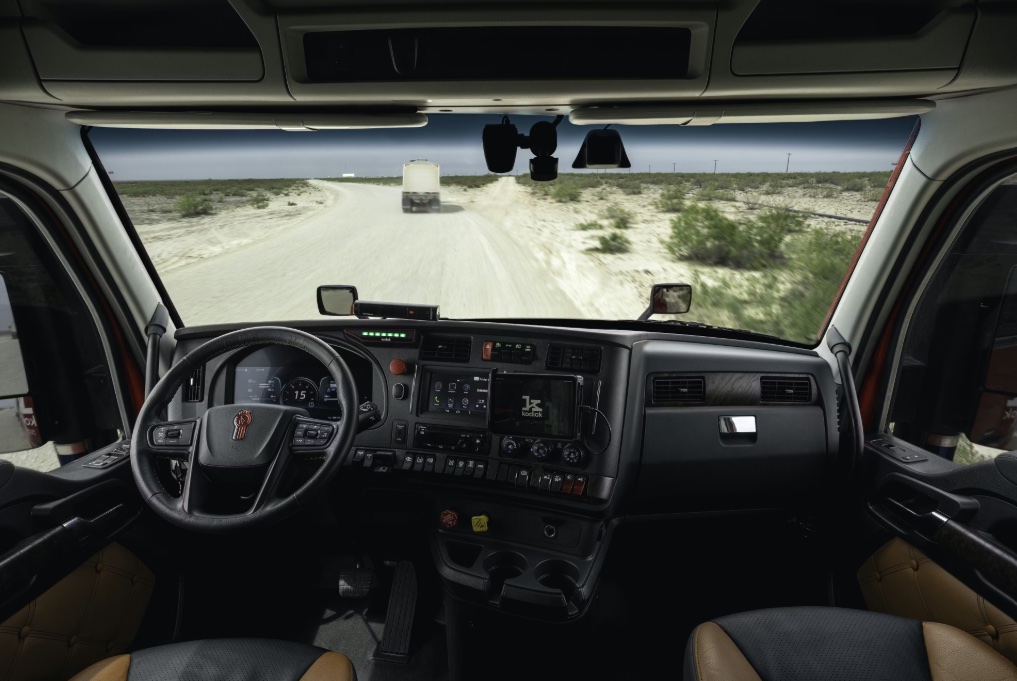
The view from inside the cab of a Kodiak automated truck.
Why Frac Sand Became the First Target
Frac sand wasn’t chosen by accident.
“It’s important, it’s heavy, it’s time-sensitive, and it’s expensive to move,” Beauchamp explains. “You’re paying a lot of drivers. And it does pay good money to drive a frac sand truck—but for operators, that’s a lot of cash out of pocket.”
A typical frac sand operation may involve:

- A $400,000 truck
- A $125,000 annual driver cost
- Dozens of vehicles cycling continuously between transload facilities and well pads
On top of that are hidden costs: congestion at pad sites, trucks stacked in line on location, drivers burning hours waiting to unload, and operators paying for time instead of tonnage.
“People don’t always see that part,” he says. “Trucks stacked up on location. Hours ticking. Those cost companies real money.”
Autonomous trucks offer a different equation. With longer operating windows, tighter scheduling, and consistent driving behavior, the potential for faster turnaround and higher utilization becomes significant. For operators, that means a faster payback on equipment and, over time, lower delivery cost per ton.
It also changes the competitive landscape between rail and trucking.
“Rail is cheaper beyond about 800 miles,” Beauchamp says. “But rail has to route through Dallas and then back to Midland-Odessa. It takes time.”
Autonomous trucks blur that line.
“For the first time, with the number of hours these trucks can run, trucking becomes competitive with rail in ways it never was before,” he explains. “If the cost is similar, why wouldn’t you want to get it sooner?”
Safety, Skepticism, and the Human Factor
Despite the momentum, Beauchamp is candid about the psychological hurdle autonomous trucks still face. “There’s an attitudinal barrier,” he says. “Waymos in Austin. Driverless trucks in the Permian. Robots rolling around. It makes people uncomfortable.”
The hesitation is understandable. Oil and gas has always been a hands-on industry, built around skilled operators, drivers, and technicians. Turning over an 80,000-pound truck to a computer challenges long-held instincts. “If I was asked if I wanted to go to space, I’d say, ‘Yeah!’, but if you ask me to go tomorrow morning… I might let a few other people get on that rocket ship first,” Beauchamp jokes. Once the novelty wears off, these autonomous trucks will be as common as the mile marker on the side of the highway. And data is adding to that steadily, softening that resistance.
“Out here, safety is actually easier to manage,” he explains. “And the safety record has been strong.” Indeed, The Permian Basin has 30 percent of all traffic accidents in Texas. The frequency out here is double the state average.
Across thousands of autonomous trips, including more than 9,000 by one vehicle and another with almost 11,000 (by some operational counts), only about three incidents have occurred, and according to Beauchamp, those accidents were attributed to the human-driven vehicles involved, not the autonomous trucks themselves.
“More data matters,” he says. “Especially in an inconsistent environment like the oilfield. And that data is growing every day.”
What This Means for the Permian Basin
For the Permian, autonomous trucking is not a novelty. It is a direct response to structural realities:
* Enormous freight volumes
* Long distances
* Persistent labor shortages
* Tight margins
* And an industry under constant pressure to move faster and cheaper
“This isn’t just about frac sand,” Beauchamp says. “Any manner of equipment, in-house trucking, aggregates, pipe, goods—eventually all of it can move this way.”
In the short term, autonomous trucks will likely remain concentrated in predictable corridors and industrial applications: sand, produced water, equipment, and bulk materials. But over time, as confidence grows and fleets scale, the scope widens.
“There are lots of people hesitant to talk about it,” he says. “But there’s also a lot of interest.”
From a wider perspective, autonomous freight is already part of long-term transportation conversations, infrastructure planning, and economic development strategy. The Basin’s role as one of the largest freight destinations in Texas makes it impossible to ignore.
From Oilfield Experiment to Logistics Blueprint
Three to five years ago, Beauchamp recalls much of the conversation in the Basin centered on re-fracs and continued expansion of traditional service models. Some of that came true. Some of it didn’t to the degree predicted.
What has accelerated instead is the search for better logistics.
“Just like anyone else in oil and gas, or any other industry, companies have to cut costs and deliver better efficiencies,” he says.
Autonomous trucks represent one of the clearest paths forward.
From Kodiak’s growing Odessa footprint, to Aurora’s expanding highway partnerships, to MOTRAN’s regional coordination efforts, the pieces are quietly falling into place. The Permian Basin, long known for pioneering drilling and completion technologies, is now helping write the early chapters of autonomous industrial freight.
And on I-20, amid the pumpjacks and pressure trucks, the future is already rolling by—one driverless mile at a time.

Christian Lombardini
Christian Lombardini, a former field operator and manager, is now a communications and content consultant for oil & gas companies and creators. You can find Christian and his The Oilfield Leader Podcast on LinkedIn.
Leave a Reply