Across the life and decline curve of a shale well, the decision about the “right” lift system for the current stage continues to morph. Wells change, and therefore so must the lift technology. As Permian wells become gassier, lift systems must adapt to stay efficient.
Often, a well starts on an electric submersible pump (ESP) during its highest production phase, then moves to some form of gas or plunger lift. In this report, we share how one company has developed a way to make ESPs work longer, and another has fashioned a way to let gas/plunger lift be efficient sooner.
Baker-Hughes Tames Gas Locking for ESPs
“Free gas is one of the main causes of unstable ESP operation, reduced drawdown, and shortened run life in unconventional wells,” said Joe McManus, product line manager/ESPs for Baker-Hughes, in an email interview.



To address that issue, the company has developed a number of gas management improvements, including their Boosted GasSep gas separator, discussed here.
It’s a step forward from their GasMaster gas separator, which had already extended ESP life “by mechanically separating free gas at the intake. But as production rates and gas-volume fractions increased in modern horizontal wells, we saw a need for a more powerful solution,” McManus said.
The Next Step
To handle the increasing gas-to-liquids ratios (GLR) in Permian wells, researchers developed the boosted gas separator concept. It’s a system that “combines a vortex gas separator with a charge pump to improve recirculation and separation efficiency under severe gas conditions.”
They used a combination of field experience, computational fluid dynamics (CFD), and iterative design refinement, looking to improve ESP performance specifically where the system tends to break down. McManus said there are more than 700 GasSeps in the field now.
How It Works—the Overview

Joe McManus
A conventional vortex gas separator uses centrifugal force to split free gas from the liquid stream. The boosted design adds a charge pump below the separator, which increases recirculation flow and strengthens the vortex inside the separator.
McManus explained, “The system helps manage pressure, flow regime, and gas separation at the pump intake, so the ESP sees a more stable fluid stream. The charge pump helps precondition the mixture and improves the separator’s ability to vent gas and recirculate liquid effectively. That reduces the amount of free gas entering the main pump stages, which helps maintain head, reduce surging, and avoid the instability that can happen when too much gas reaches the impellers.”
The effect is to stabilize current draw, giving better drawdown. It improves production continuity by reducing gas interference events that would otherwise slow or stop production.
He added, “By removing more free gas before it enters the production pump, the boosted separator helps the ESP operate in a more stable hydraulic window. That reduces the risk of gas lock, reduces cycling and gas-related stress, and helps extend run life while supporting higher sustained production.”
This Makes ESPs Viable Longer
This has the result of letting ESPs keep operating later in a well’s life than before, McManus said. “The most significant value to the producer is that it expands the range of wells where an ESP remains the optimal artificial-lift choice. Operators are constantly balancing artificial-lift options based on rate potential, drawdown, gas handling, reliability, and total system economics.” ESPs generate high production rates while aggressively drawing down pressure, which improves production more than other production methods.
“A boosted system helps preserve that ESP advantage. By improving gas separation ahead of the main pump, it allows ESPs to remain viable in wells that might otherwise be pushed toward gas lift or high-pressure gas lift,” he said.
And, he added, “Next generation systems extend ESP viability in high-GLR wells, helping operators maintain stronger drawdown, higher production, and the performance advantage that makes ESPs so attractive in the first place.”
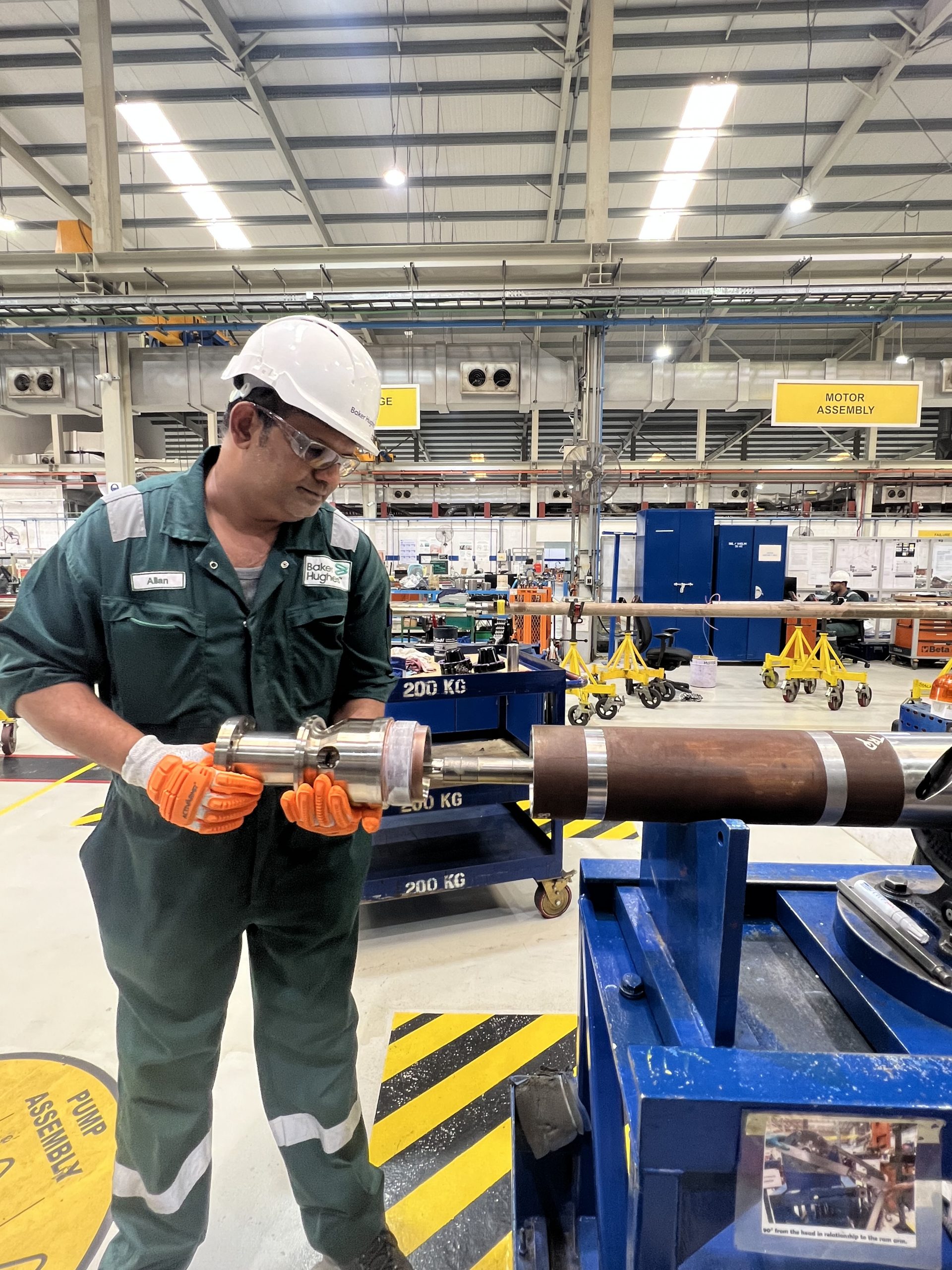
Seen here is a booster gas separator.
In the Field
While the GasSep is deployed across many Baker-Hughes’ basins, the Permian is the focus for this publication.
McManus discussed a Permian application in which the company deployed a 400 Series LIFTPrime high-efficiency E2000 pump with a boosted gas separator. As a result, “The system reduced pump intake pressure from about 420 psi to 323 psi and increased average production by about 30 percent,” improving the well’s performance and economics.
Making Plunger Lift Efficient Earlier in a Well’s Life
“I wish I would have had this product years ago.” That’s how Flowco’s Mitch Boyd sees the company’s SurgeFlow plunger lift lubricator. Boyd is the company’s VP for Plunger Lift. Joe Irvin, Flowco’s U.S. Southern Region Manager, was involved in the early development and field trials of SurgeFlow.
To explain SurgeFlow’s advances, let’s start with what the lubricator does, and the challenges previous systems presented in the field.
Boyd describes it this way: “A plunger lift lubricator is the pressure-containing assembly installed on the wellhead to receive the plunger safely at the surface. The lubricator cushions and controls the plunger’s impact, provides flow paths for gas and liquid production around the plunger, and allows for safe retrieval and inspection of the plunger.”
Challenges

Surgeflow is a new kind of plunger lift lubricator.
A shale well’s production decline curve is steep, usually necessitating a progression of artificial lift types across its life. Due to high initial production, most wells begin with electric submersible pumps (ESPs). Then, Boyd said, there’s a progression of other solutions until it’s time for plunger lift, gas lift, or a combination—plunger-assisted gas lift (PAGL) or gas-assisted plunger lift (GAPL).
Before the shale revolution, he recalled, plunger lift was not usually put in play until a well’s production dropped to about 50 barrels per day. He explained, “Traditionally, operators installed an 8-round threaded lubricator rated for 3,000 psi. As shale wells came online, average production often moved beyond 500 mcf/day with 100 barrels per day. At that point, flanged lubricators rated at 5,000 or 10,000 psi became commonplace.
Moving to plunger lift at those levels created some new challenges, Boyd related. “We started integrating flanged lubricators on these higher-rated wellhead assemblies.” In that process, the wellhead had to be disassembled and rebuilt with a large number of individual fittings. There were also adaptations along the way, but the bottom line was that “it became an all-day installation with welding and fabricating, and that’s how it was for years.”
There was lost production, there were lots of man hours, there was welding and refitting, there was pressure testing, there were safety issues, etc. Costs and delays were significant, and those in the industry knew something had to change.
“There Is a Better Way”
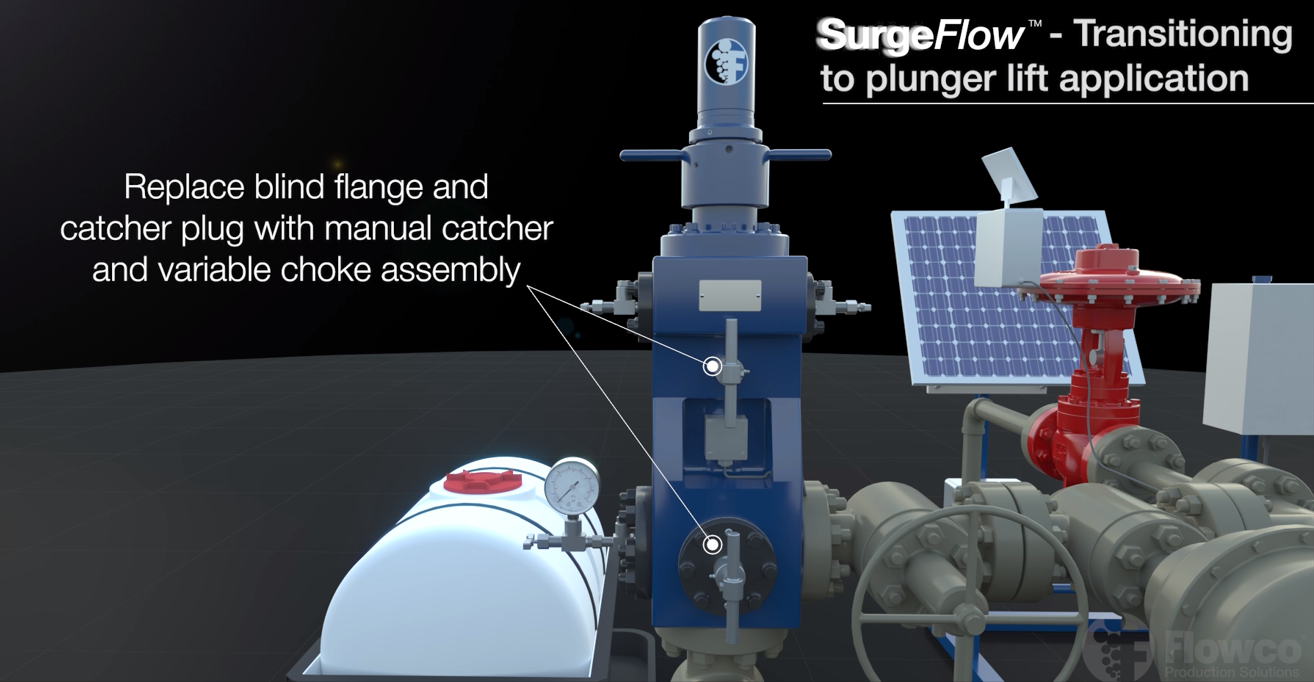
SurgeFlow can be installed by one person in less than an hour, often about 15 minutes, reducing production downtime. Its 360-degree flow exhausts natural gas across all areas of the plunger and controls the plunger’s impact when it reaches the surface, extending the plunger’s life.
“Flowco began developing multiple drop-in style flanged lubricator solutions in 2018, until we evolved to the most advanced technology in wellhead ‘drop-in’ lubricator solutions today, Surgeflow,” Boyd said.
It was developed in its current form in 2024, with field installations growing exponentially each year.
In short, SurgeFlow is a modular, single-component plunger lift lubricator that simplifies formerly complex systems into one piece, which can adapt to the changing phases of production. It reduces costs involving downtime and man hours required by older systems in the changeout phase, while also reducing equipment wear on the plunger and improving safety.
It can be installed by a crew in very little time. “You just change out a single flange with modular variable choke lower outlet assembly. It takes about 15 minutes, and one person can do it.”
In fact, Boyd noted, an increasing number of clients want SurgeFlow installed from the start of production. It’s designed to handle the flow capacity of a standard flow block during initial high-rate production, so when it’s time for the plunger lift, the SurgeFlow lubricator is already in place.
Even with plunger lift’s ability to engage at higher production rates, it’s still among the most economical options at the old 50 barrel-per-day levels, adapting to flowing well conditions for the life of the well. That means, said Irvin, “We can take it from very high flow rates all the way down to the end of life of the well with plunger lift. We can manage the flow as needed and start adjusting various ports to control plunger arrival and impact as the well depletes.” All this is accomplished without replacing the lubricator at any point.
Flow 360 Increases Production
SurgeFlow allows oil and gas to flow all around the plunger, 360 degrees. In addition to increasing flow capacity, that 360-degree flow ability exhausts gas across all areas of the plunger, helping control the plunger’s impact when it reaches the surface. That makes it safer and increases the plunger’s life span.
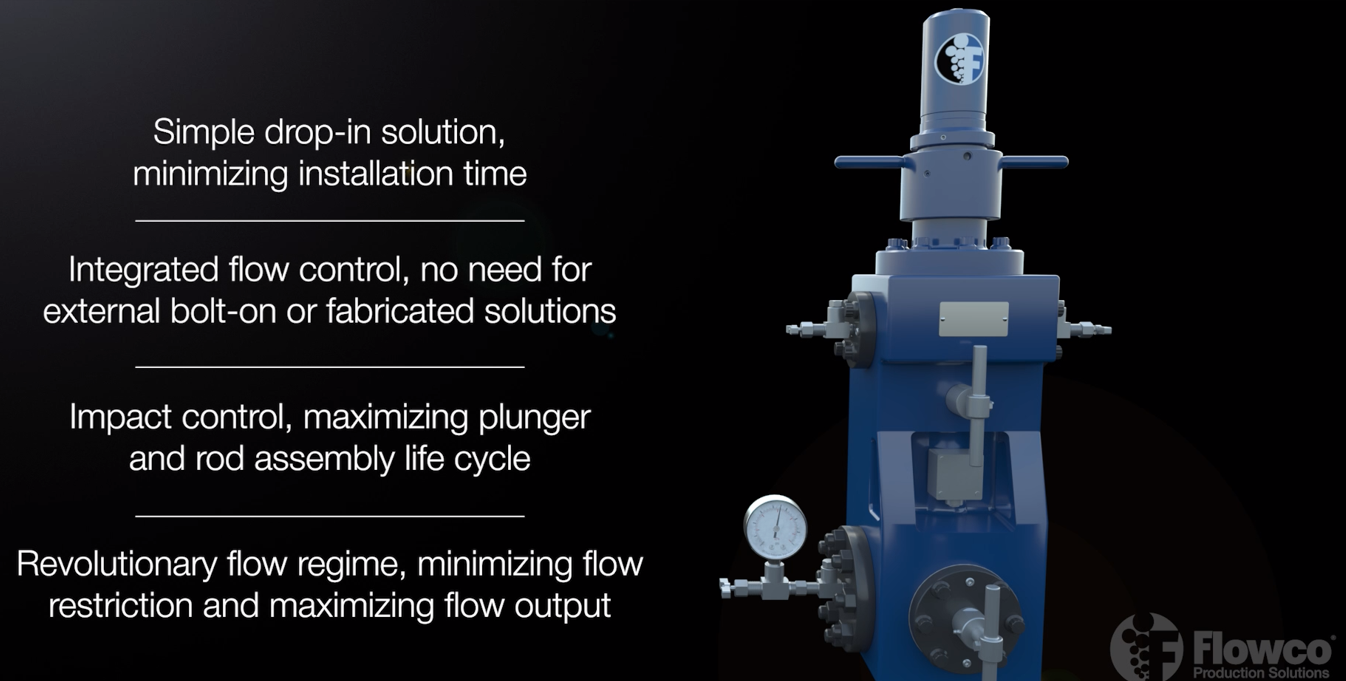
Flowco’s SurgeFlow is a modular, single-component plunger lift lubricator that simplifies formerly complex systems into one piece, which can adapt to the changing phases of production.
Simplicity In the Field
Irvin, as the southern region manager, notes the reactions to SurgeFlow in the field. Customers see “The simplicity of the compact solution with its integrated features. And they see the great benefits throughout the lifecycle of ownership, and how easily it adapts to changing well conditions.”
He continued, “And we can take it from nearly a 1,000 bbl/day well, depending on tubing size, all the way down to the end of life of the well with plunger lift.”

Paul Wiseman
A longtime contributor to PB Oil and Gas Magazine, Paul Wiseman is an energy industry freelance writer.