I sat for longer than I’d care to say at the side of I-20 one morning mid-April. Just west of Midland, at a corner everyone drives by, but no one remembers. I counted large oilfield service trucks for about an hour. Well, I tried anyway. My informal experiment ended just as informally: I lost track of how many trucks were actually going by. Well over 100. And now I need coffee.
As I drove back towards 12 Gate in Midland, I began to think about what was, in fact, happening. The Permian Basin is usually described in terms of production: two million barrels here. Five million barrels there. Rig counts, lateral lengths, frac intensity, export capacity. The Energy Information Administration (EIA) reported that Permian tight oil and shale formations produced about 6 million barrels per day of crude oil and 22.2 Bcf/day of dry natural gas in December 2025, and the broader Permian region accounted for about 48 percent of total U.S. crude oil production in 2025. The language of the Basin has traditionally been the language of extraction. Not that it’s wrong, but it doesn’t explain the whole picture. There’s a lot more happening in the modern Permian.
Every barrel produced depends on a deeper system beneath it: a vast industrial choreography of trucks, railcars, pipelines, dispatchers, yards, sensors, drivers, pumps, software platforms, loading terminals, maintenance schedules, and routing decisions operating across thousands of square miles in real time. The data collected is sent to hundreds, nay, thousands of people, in the Permian, in Houston, and around the world. Scores of skilled engineers, analysts, decision makers, and field operators use this data to understand current operational posture, and how to make the next critical decision.
The Permian is not merely an energy province. It is a logistics architecture that outpaces anything else in the United States. And increasingly, its competitive advantage may depend less on how fast it drills and more on how intelligently it coordinates movement, visibility, and flow.
Because in the modern Basin, operational excellence no longer belongs solely to the company that can move the most material. It belongs to the company that can see the system most clearly.


Mobility, Bulk, and Flow Networks
The Basin’s Physical Economy
If you spend five minutes standing anywhere in the Permian and you begin to realize that nearly everything else is moving. Before the sun comes up over the flat, dark coolness of dawn, trucks already line sections of Interstate 20 and Highway 285. Hotshots and lease operators crisscross caliche roads carrying tools and equipment. Water haulers cycle between disposal wells and pads. Seemingly a thousand beaches worth of sand is moving down the road. Pipe yards load and unload continuously. Chemicals, diesel, casing, compressors, pumps, generators, and crews all travel across the Basin in overlapping streams and overlapping patterns.
The oilfield is not static infrastructure. Even the assets that don’t move, like pump jacks and SWDs, are busy like rush hour. It is all organized motion. At its most fundamental level, the Basin operates through three interdependent logistics networks: mobility, bulk, and flow.
Mobility is the movement of people, equipment, and operational inputs across the Basin’s road and highway system. Every operator, tech, mechanic, completion crew, electrician, and field supervisor depends on this network. The Permian’s geography alone makes mobility a strategic challenge. Assets are dispersed, distances are large, and timing matters constantly.
Bulk is the movement of high-volume materials: sand, water, chemicals, fuel, and consumables. Modern shale production requires industrial-scale material throughput. A single frac operation can consume millions of barrels of water and thousands of tons of proppant in compressed time windows, meaning logistics failures quickly become operational failures.
Flow is the movement of hydrocarbons themselves through gathering systems, pipelines, compression infrastructure, storage assets, and export channels. Midstream systems form the Basin’s circulatory network, quietly determining what can move, where it can move, and how efficiently production reaches market.
These are often discussed as separate sectors of the industry. In reality, they function as one interconnected system. A delay in trucking affects frac schedules. A pipeline constraint changes storage behavior. Congestion at a terminal impacts driver availability elsewhere. Water infrastructure affects drilling economics. Rail availability influences chemical and sand sourcing strategies. Everything touches everything else.
Morgan Rascoe, Water Logistics Coordinator at Oxy, put it this way, “Logistics is the first impacted. Even bad weather at the Port of Houston can reroute ships and their west Texas-bound cargo to Miami, Florida, increasing transportation costs.” This is the recognition of the shared dependency of all the systems and networks simultaneously. This interconnectedness is becoming one of the defining realities of the modern Permian. The Basin’s true scale is not merely measured in production volumes. It is measured in coordination.
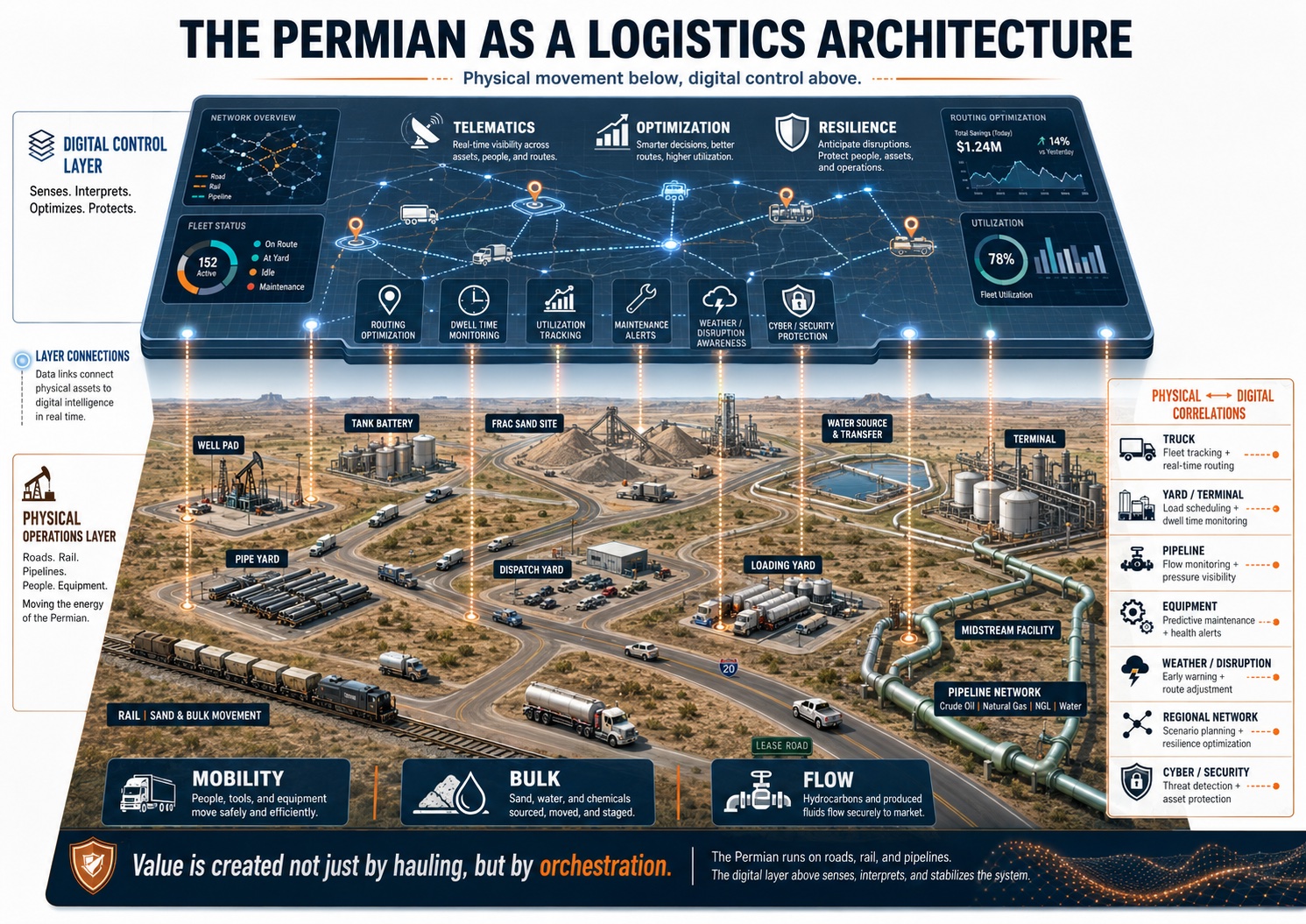
Illustration by Christian Lombardini
The Control Layer
Telemetrics, Optimization, and Resilience Above the Physical System
For decades, much of oilfield logistics operated through human intuition and fragmented communication.
Dispatch relied heavily on phone calls and radios. Fleet visibility was partial. Delays were often discovered after they had already cascaded downstream. Utilization data arrived late. Maintenance problems became emergencies instead of forecasts.
The modern Basin is evolving beyond that model. Today, a growing control layer sits above the physical logistics network, one built around telemetrics, optimization systems, and operational visibility. The trucks still move. The pipelines still flow. The roads remain crowded. But now the system increasingly watches itself in real time.
Telematics systems track vehicle location, idle time, fuel consumption, engine diagnostics, braking behavior, utilization rates, routing efficiency, and dwell times. Dispatch platforms monitor loads dynamically. Fleet software flags maintenance risks before failures occur. Sensors monitor pressure, throughput, vibration, and performance across infrastructure networks.
The result is not merely more data. It is industrial awareness. “You can’t optimize what you can’t see” has become an increasingly important operational reality in the Basin. Visibility itself is now a competitive advantage. That visibility matters because the Permian operates under constant pressure. Weather disruptions, traffic congestion, labor shortages, equipment failures, cybersecurity threats, and infrastructure bottlenecks all introduce instability into the system. In an operational environment this dense, resilience becomes inseparable from information.
A logistics network that cannot sense disruption early cannot stabilize itself quickly. This is where optimization enters the picture.
Optimization is not simply route planning. It is the attempt to reduce friction across the entire operating environment. Routing decisions, load balancing, maintenance scheduling, asset utilization, and timing coordination all become part of one larger objective: keeping the system moving efficiently while minimizing waste and downtime.
One of the pioneers of this new interconnected system is Jim Tracy, founder of SkyLink. Jim sees the future pretty clearly: “Basic GPS tracking tells you approximately where something is. The SkyLink X-1 would combine: GNSS/RTK for centimeter-level positioning where corrections are available, UWB for close-range equipment/personnel positioning where GPS is weak, LTE/Ethernet/IP communications for backhaul, edge compute for local decisions, alerts, and automation, and timing synchronization for drones, sensors, cameras, and industrial systems. That makes it more than a fleet tracker. It becomes a field infrastructure layer.”
In many ways, the Basin is transitioning from reactive logistics toward predictive logistics. And that shift changes the meaning of operational discipline itself.
The Shift From Hauling to Orchestration
Why Coordination Now Creates Value
There was a time when logistics in the oilfield was viewed primarily as hauling. Move the sand. Move the water. Move the pipe. Get the truck there on time. Those fundamentals still matter and they always will. But the Permian has grown too operationally dense for movement alone to define success, or excellence.
Today, value increasingly comes from orchestration. The difference is subtle, but important. Hauling focuses on transactions. Orchestration focuses on systems. A hauling mindset asks whether a load arrived. An orchestration mindset asks whether the entire network performed efficiently together.
That distinction becomes critical in a basin where thousands of simultaneous activities interact continuously across roads, pipelines, terminals, and field operations. The next stage of logistics evolution in the Permian is likely not about adding more trucks indefinitely. It is about reducing friction inside the network itself.
Idle time becomes a cost center. Congestion becomes a production issue. Visibility gaps become operational liabilities. Downtime becomes a systems problem rather than an isolated event.
This is one reason connected fleet technologies, automation tools, and data integration platforms are drawing increasing attention across the industry. Autonomous capabilities have already come into use, and will eventually play a larger role, but even before full autonomy arrives, connected systems are already changing how operators think about coordination.
In many respects, modern logistics companies increasingly resemble software companies attached to physical infrastructure. The physical movement still matters. Deeply. But the strategic differentiation increasingly comes from information flow layered on top of material flow. The Basin is beginning to understand that operational intelligence itself is infrastructure.
Infrastructure, Data, and Discipline
The Strategic Implication for the Permian
The Permian Basin’s next chapter may depend less on sheer expansion and more on system integration. For years, the industry’s defining challenge was scale: drill more wells, move more material, expand takeaway capacity, build additional infrastructure. Those pressures still exist, but the modern challenge is increasingly one of synchronization.
Can roads, pipelines, rail systems, dispatch networks, fleet telemetry, maintenance systems, and operational planning function as one coherent operating environment?
Because if they cannot, inefficiency compounds rapidly. This is why logistics can no longer be viewed merely as a support function. It has become a strategic capability directly tied to production reliability, cost control, safety performance, and organizational resilience.
Legacy systems such as GPS and satellite internet are being leap-frogged by new technologies that integrate all this motion into one contextual feed.
The Basin’s future advantage may not belong solely to the operator with the largest acreage position or the biggest balance sheet. It may belong to the operator, midstream company, or logistics provider that best integrates physical infrastructure with operational intelligence.
That is a different kind of competitive edge, and perhaps a more durable one. The Permian has always been a story about geology, capital, and engineering. Now it is increasingly becoming a story about coordination. About whether one of the largest industrial regions in North America can evolve from a collection of moving parts into a truly integrated operating system.
As I sipped on my coffee back in Midland, I thought about what Morgan had told me, “Everyone has the authority to say ‘No.’ Very few have the authority to say, ‘Yes.’” Saying no to new technologies, protocols and systems will retard the growth of some companies. Those that don’t make capital investments will be caught flat-footed at the gate while the race has already begun.
Beneath the headlines about production volumes and export records lies another reality: The Permian Basin runs on logistics. The companies that truly understand the systems they are working within and learn to master both movement and visibility may ultimately define what the next era of logistics means in the Permian.

Christian Lombardini
Christian Lombardini, a former field operator and manager, is now a communications and content consultant for oil and gas companies and creators. You can find Christian and his The Oilfield Leader Podcast on LinkedIn.