









Click here to listen to the Audio verison of this story!
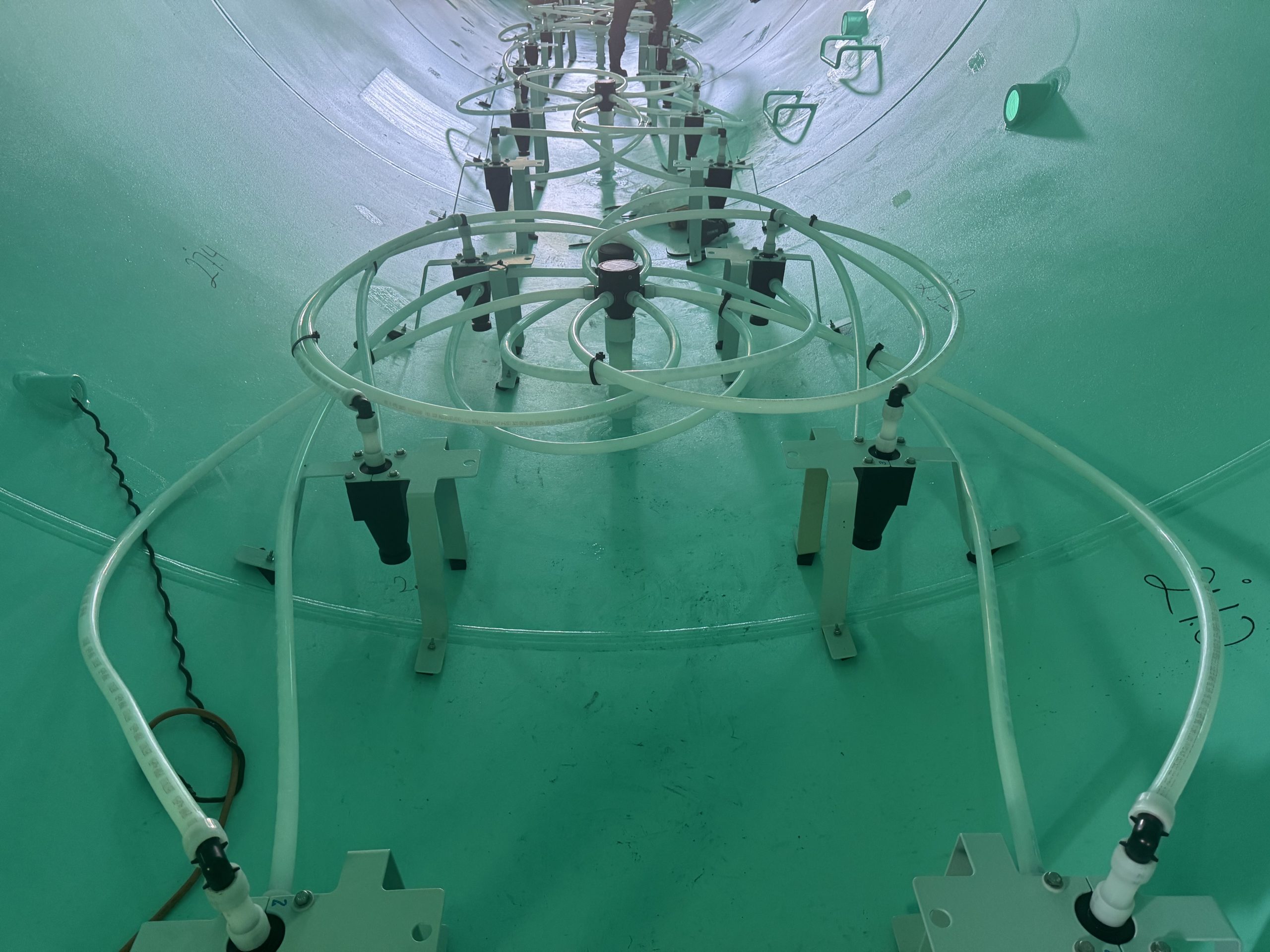
Visible in the background of this page are the working parts of the “Octopus” tank solids remove system marketed by GRUNT Oilfield Services.
For today’s oilfield service companies—called OFS for short—improving or adding services is a necessity. E&Ps are pushing for more efficiency and more accuracy, and OFS companies must equal that or be left in the dust.
The author of the article you are about to hear is Paul Wiseman, a regular article contributor to Permian Basin Oil and Gas Magazine.
Growth can be accomplished by developing systems internally, as with Baker Hughes. Or by recognizing a golden opportunity to take on a cutting-edge product, as did GRUNT Oilfield Services.

In June of this year Baker Hughes announced the launch of GuardVibe, the culmination of almost 20 years’ worth of research and improvements toward reducing vibrations in the drilling process. Described as a “torsional vibration dampener,” it is designed as an alternative to bit-managed stick-slip reduction. Its goal is extending the life of bottom hole assemblies, called BHA’s for short, in drilling.
GuardVibe uses “internal inertia mass to counteract the effect of torsional vibrations.” Daniel Bell, the company’s Senior Global Product Manager—Downhole Motors and Hole Enlargement, who was part of the development team, said the original idea arose around 2007. He recalled that some of Baker Hughes’s engineering teams were concerned about, as he said, “trying to understand some of the BHA oscillations and the damage they were seeing in then-relatively-new rotary steerable technology used in the shale revolution’s early days.”
After some first steps in 2010-12, in 2019 the team developed a high frequency torsion isolation tool (HFTI, for short). Bell said the HFTI “goes directly on top of the steering head in place of a modular motor.” He said it worked well and was a key step forward while still needing further improvements.
To keep from picking up bad vibrations, Bell said “…the engineering team looked it over and identified a dampening design like what you see in large high-rise towers for that excitation from earthquakes and wind and how they dampen the impact of that to reduce that damage overall.”
There is a difference: buildings are fixed and don’t rotate like a drill string, Bell said, “But the actions that we’re taking from an earthquake or high winds are almost identical to that.” Bell and the team made some adaptations.
The end result was, he said, “a self-contained system that doesn’t require any kind of electrical components, any mechanically moving components. It’s just there to produce an opposite force when it reaches a certain level of erratic oscillation and then turn to dampen that force.”
Avoiding moving parts and electronics was a key part of making the tool reliable when it’s a mile—or three—downhole.
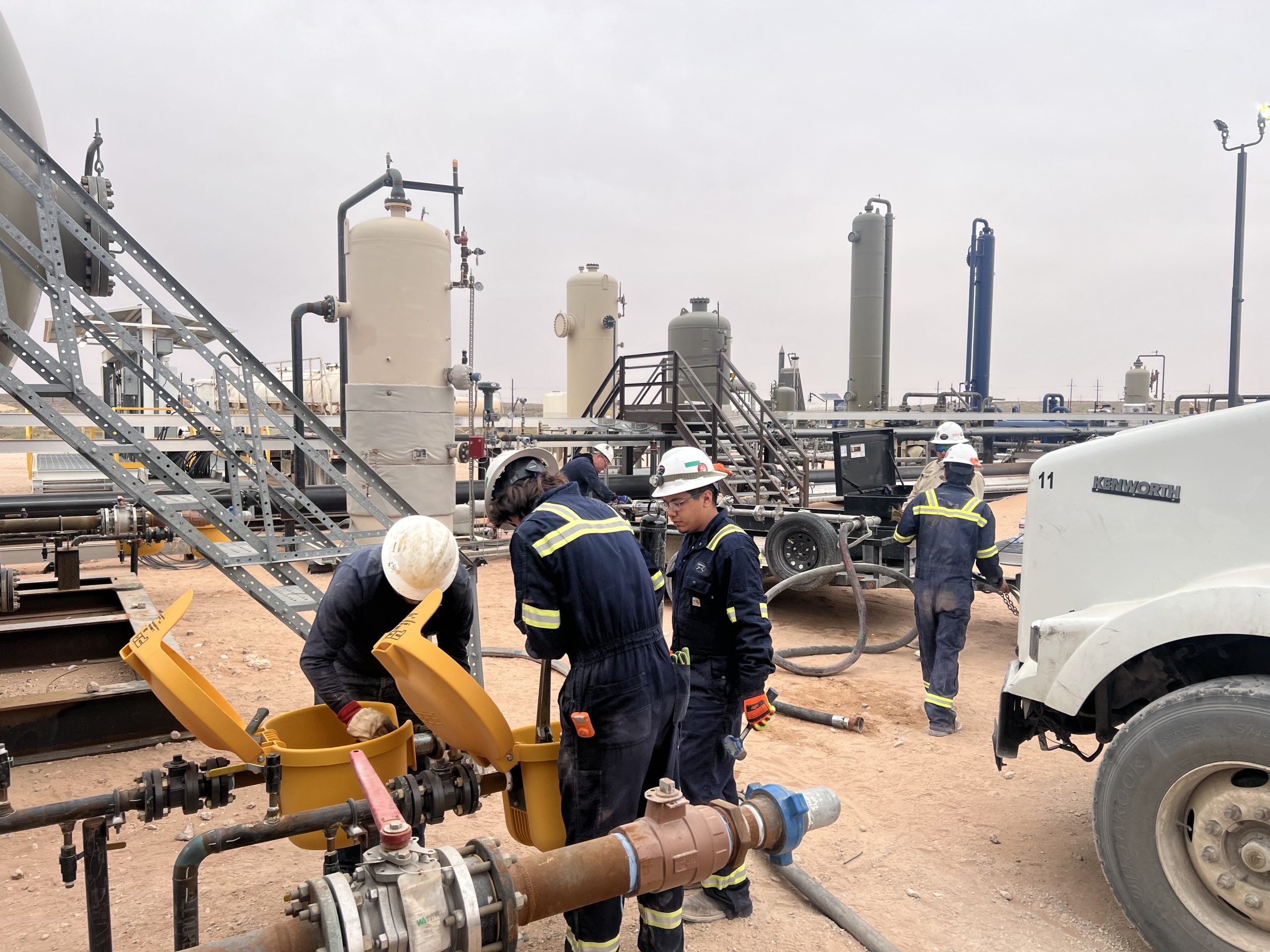
GRUNT Oilfield Services went from one truck and one trailer to 20 trucks, 30 trailers, and about 30 employees.
Along with the hardware, there was a software component. They created modeling software to interpret the data to adapt to each situation individually and to improve the system as a whole. Part of the improvement process, Bell said, lay in the ability to “…push the parameters and exceed what we’ve been doing and start making better ROP and increase reliability across our tools.”
When asked if this eliminates or reduces these issues, Bell said it’s eliminated all significant issues, but none “have gone to the point of destruction,” or to a high-frequency torsion oscillation incident big enough to be loggable.
While these issues can sometimes arise in vertical wells and the vertical part of a horizontal, Bell said the real need for this kind of tool is in long laterals. He added that horseshoe laterals add only slightly to the need because, while there may be more vibrations in a horseshoe, the tool is still able to handle them.
The bottom line for new technology is always, “How does this make things better?” To this question, Bell said they are seeing increased ROP (rate of penetration) for two main reasons.
He remarked, “One, we’re seeing longer life out of the technologies in consistent formations.” He noted that there can be individual exceptions in any formation, but the improvements have been generally true.
Second, GuardVibe speeds ROP by removing from the process the previous need for in-path adjustments to mitigate vibrations. These could include things like weight-on-bit reductions, RPM changes, bit design and others, all of which slow the ROP.
One Wolfcamp operator for which the process was using third party mitigation tools was averaging 9 days and using 2.1-2/2 BHAs. After Baker Hughes implemented some parameter changes and bit design adjustments, they dropped the average time to 7.2 days and 1.5 BHAs.
After further pushing parameters with the third-party tool and seeing the average BHAs increase, Baker Hughes brought in GuardVibe and dropped the average to 4.7 days and the BHA down to 1.2. That cut the original ROP almost in half and the BHA usage by more than half. “And the wild thing,” Bell said, “is that it literally happened immediately from implementation. It wasn’t like we worked our way up. We just dropped it.”
With extensive data collection from each job and the ability to have computers crunch those numbers, Bell said they plan to continue to push the parameters in order to further increase the ROP while reducing costs.

Spooling cable work for electric submersible pumps is a mainstay job for GRUNT Oilfield Services.
In a different development, at a different service company, GRUNT’s leadership jumped on an opportunity in a “chance” meeting of friends at a trade show. Now that product, the Octopus, accounts for 40 percent of their business. The Octopus is a tank solids removal system made by Wolf Process Technology.
But the back story for the company involves three military veterans working in the oil industry who wanted to escape the corporate world and control their own destiny.
Jeff Lightsey (CEO) Army, Jaran Chesser (VP of operations) Marines, and Wes Hall (COO) retired Army Ranger, all three of them owners of GRUNT, are military veterans who served in different combat zones and regions around the world. After serving, at separate times, in the military, they all returned to Texas to work in the oil field. Chesser and Hall had worked as spoolers for several of the large service companies and Lightsey had worked in drilling, completions, and operations for several major E&Ps.
Over time, Chesser and Hall became disenchanted with the corporate mindset, and a significant merger of a company Hall and Chesser had worked for pushed them to look for a way to go out on their own.
Lightsey recalled, “That’s when they said they had enough of being just another spooling company and they called me and said, ‘Can you come run this and grow our company for us? We’re the workers, you’re the brains.’”
In 2018 $1.5 million Patriot loan available to veterans kick-started their venture, although Lightsey proudly says they only utilized $1 million of it, “paid it back in 18 months, and we’ve been self-funded ever since.”
With that money, he said, “We started the company with a pickup and one trailer, and we’ve expanded it to over 20 trucks and over 30 trailers.”
They’re up to about 30 people as well. They have a shop in Seminole, centrally located between New Mexico and Midland/Odessa, with the office back home in Houston.
Their fiscal responsibility served everyone during the COVID shutdowns, as they were able to keep 100 percent of the staff on the payroll, even though few of them had anything to do. Lightsey and the other founders consider everyone to be like family, and they wanted to keep everyone where they could pay their bills. He added that their staff is about 75 percent veterans because, as he said, “most of the time they’ve got a family to feed, and they know what it’s like to roll up their sleeves and get dirty.”
Which brings up the name, “GRUNT.” “It’s a military term,” Lightsey explained. “Whenever you’re effective, you’re called the grunt.” And they do want to be effective.
Spooling cable work for electric submersible pumps (ESPs) is the main thing, but the aforementioned Octopus business is picking up significantly. That opportunity came about through a chance 2023 encounter at a conference between Lightsey and an old friend who had started working for Wolf. Excited about the new Octopus product, his friend recommended to Lightsey that GRUNT become the area’s exclusive distributor and service company.
When oilfield storage tanks get filled with produced sand and sludge, it’s usually an expensive and time-consuming job to take vessels offline, then to clean them out. Often, the opening of the tank vents methane as well.

Crew members at work at GRUNT Oilfield Services.
Lightsey explains that the Octopus is installed once and can be run once solids build in the vessels or tanks through a patent pending portable manifold system. He said, “There’s no more venting gas, there’s no more confined space, there’s no more taking the vessel offline or shutting off/diverting production. We can clean that vessel in an hour and a half—previously that would have taken two days to clean out.”
During that time the vessel stays at its regular operating pressure and flow rate. “It’s like we were never even there,” he said. Well, other than that the fact that vessel or tank is clean.
Sand, sludge, and other unwanted substances exit the vessel/tank through the Octopus’s manifold into a vacuum truck, which hauls it off to the designated disposal.
In the field, Lightsey related that a major client had told him privately that they’d seen about a 19 percent production increase in the field where the Octopus was installed. Operators are also releasing flow back within days versus weeks with the Octopus installed. This way they can recover their initial capex for the Octopus within a few days of releasing the expensive flowback personnel and equipment that were previously required.
Before the Octopus, GRUNT did not have or need a sales department. Lightsey says word of mouth kept them very busy. But Wolf, understandably, wanted to jump-start sales of its new product, and required the company to hire salespeople at least for that.
As seen in the handling of COVID staffing, Lightsey and his compadres consider everyone to be family. He said today’s producers want work done faster and more efficiently than ever before, and GRUNT has the staff to do that because they tend to stay on. Many staff members, he said, have been with them since day one.
Anyone not moving forward is getting left behind, and these two businesses are among the hundreds of OFS companies at work in the Permian who are moving in the right direction.

Paul Wiseman
A longtime contributor to PB Oil and Gas Magazine, Paul Wiseman is an energy industry freelance writer.