The battle over ethanol as an added fuel ingredient to gasoline and diesel fuels has been around for going on 50 years. And occasionally it flares up when certain measures or mandates come to the fore in our nation’s capital. Because ethanol is produced by corn farmers, the corn lobby (and agriculture in general) is the prime motive force involved in keeping ethanol mandates in place. Some objections to ethanol arise from free-market apologists who oppose the public sector involvement in what they think should be left to the markets to resolve naturally (and thus, presumably, without ethanol). Other objections come from other camps (as will be seen below), but the fact of the matter is that ethanol in our fuels is a contentious issue, and this year has seen a spike in those contentions, as ethanol’s backers are pressing President Trump and other Washington-based politicians to increase the ceiling on how much ethanol (proportionally) must be used in the fuel mix.
We share thoughts below from three sources.
First, a group that typically is opposed to oil and gas interests, Oil & GasWatch, weighs in with a “no” position. On July 9, they commented in their Newsletter:
“President Donald Trump’s best-known energy slogan is ‘drill, baby, drill,’ but it could also be ‘plow, baby, plow’ because of his recent efforts to boost federal support for plant-based biofuels as a favor to voters in farm states.
“However, the political maneuver could result in both more pollution from biofuel factories and higher prices in supermarkets, as food consumers increasingly compete with biodiesel manufacturers.


“In March, the Trump Administration updated the U.S.’s Renewable Fuel Standard to require more plant-based fuel to be used in American cars and trucks than ever before, drawing praise from soybean farmers and agribusiness groups. Fossil fuel refiners and environmental advocates have criticized the standard, though not for the same reasons.
“The new standard requires refiners and fuel importers to blend in record-high amounts of plant-based diesel – 60 percent more than last year. The change is the largest annual increase in the program’s history, according to commodities analysis group Argus. The administration also maintained an existing mandate to blend 15 billion gallons per year of corn ethanol into motor gasoline.”
So much for Oil and GasWatch. Now we hear from Alex Epstein, an author who writes about hydrocarbons and their place in society.
“The corn lobby, joined by many oil lobbyists, is pushing a bill to expand the ethanol mandate by 1) loosening air quality rules and 2) imposing the mandate on small refineries. This will raise fuel costs. Advocates of expanding the ethanol mandate not only have the gall to pretend they are increasing freedom when they are reducing it, they are also pretending they will lower fuel prices when in fact expanding the ethanol mandate can only raise prices.
“Here’s why the ethanol mandate increases fuel costs while providing no benefits (except to corn farmers and lobbyists), and why expanding it will only make fuel costs worse.
“Note: I use ‘the ethanol mandate’ as shorthand for the Renewable Fuel Standard, which mandates the use of ethanol as well as certain other biofuels.
“The ethanol mandate directly increases the price of fuel by forcing us to buy ethanol when it’s more expensive.
“The ethanol mandate forces around 7.5 billion gallons of ethanol into gasoline each year that would likely not be used in a free market (assuming most gasoline would be E5 in a free market). Thus, when ethanol is more expensive than gasoline, the mandate raises costs by 7.5 billion times the price differential of ethanol and gasoline.
“In 2025, when ethanol was roughly 40-50 cents per gallon more expensive than wholesale gasoline (after accounting for ethanol’s lower energy density), the ethanol mandate could be estimated to add replacement costs of over $3 billion, or over 2 cents per gallon.²
“Supporters of the ethanol mandate like to point out that ethanol can be cheaper than gasoline when oil prices are high—as is the case right now.
“But any modest benefit from cheaper ethanol would occur in a free market in fuel with no mandate—because retailers and consumers could freely choose higher ethanol blends when they were cheaper. Yet the corn lobby has repeatedly rejected fuel freedom proposals.
“A new E15 law would make no difference to prices this year, since current law already lets the federal government allow year-round E15 on a case-by-case basis—and it has already done so this year.
“Ethanol lobbyists don’t want Congressional year-round E15 for any other reason than to permanently expand the ethanol mandate so we always have to pay for a lot of ethanol—no matter how expensive it is.
“The ethanol mandate increases the price of gasoline by up to $0.30/gallon by forcing refiners to buy expensive biofuel credits whose costs get passed onto us.”
Epstein goes on to outline cost impacts on gas stations and other facilities that are forced to make investments in their refineries or their ethanol blending equipment. It’s a complicated issue, and nothing is ever as simple as Congress or a lobbyist wants to describe it.
Now, lastly, we turn to the American Petroleum Institute (API), and their commentary (the most recent of the three shared here) from July 22, an article entitled “A Gas Price Lever Washington Already Holds”:
“What if we told you that something was adding upward pressure to the price of every gallon of gasoline sold in the United States, and it has nothing to do with the Strait of Hormuz or global energy markets?
“Record-high biofuel mandates are affecting the price of gasoline, and the EPA’s Renewable Fuel Standard program can be adjusted to help reduce costs.
“First, what is the Renewable Fuel Standard?
“The Renewable Fuel Standard (RFS) is the government program that sets how much biofuel must be used. Although biofuels play an important role in America’s fuel supply, there are practical limits.
“Here’s how the RFS works: Each year, the EPA announces how many gallons of biofuels must be blended into the nation’s fuel supply. That requirement is called the Renewable Volume Obligation (RVO). Refiners and fuel importers must then prove to the government that they met the requirement by submitting credits called Renewable Identification Numbers, or RINs.
“RINs can be thought of as the ‘currency’ of the RFS program. A RIN is generated with every gallon of biofuel produced (one per gallon of ethanol; higher-energy fuels like renewable diesel generate more than one). Once the biofuel is blended with gasoline or diesel, the RIN is “separated” and can be traded on the open market. Companies have three ways to get RINs: blend biofuels they produce, blend biofuels they purchase, or buy RINs on the open market.
“That last option is important because RINs are traded—like commodities—on financial markets. And just like commodities, RIN prices rise and fall with the balance of supply and demand. This year, demand for RINs is currently outpacing supply, and prices are near record highs.
“The problem with this year’s record-high renewable volume obligation.
“The EPA’s latest RVOs set record-high biofuel volume requirements—the largest in the program’s two-decade history. For 2026, companies must submit 26.81 billion RINs, equal to about 15.5% of every gallon of gasoline and diesel sold in the country.
“There is nothing inherently wrong with higher volumes of biofuels. If the biofuel requirement increases along with the production of biofuels (and their RINs), the market can adjust. But right now, the RVOs appear to be set higher than the volume of biofuels—and therefore RINs—on the market. That creates a problem.
“With the RFS program requiring more RINs than are currently being generated, the market has bid up the price of compliance with the RFS. RIN prices have more than doubled since the start of 2026.
“The RIN credits companies buy to show compliance now cost roughly twice what they did in January 2026.
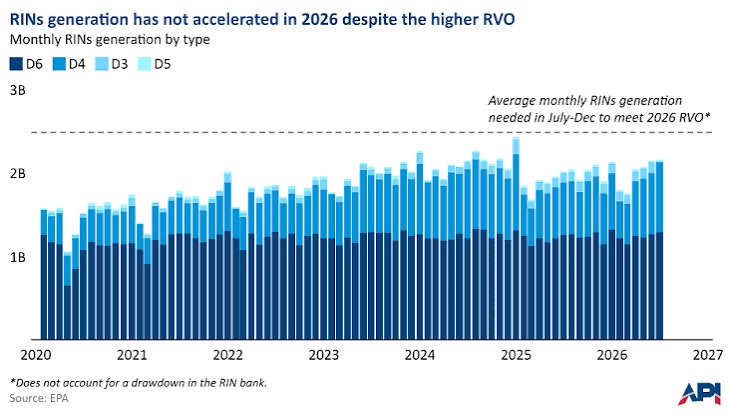
“Fortunately, adjusting the RFS does not require an act of Congress. EPA currently has statutory authority to adjust mandates it has already set to reflect market conditions.
“Aligning the RVO closer with the volume of biofuels producers can realistically supply would help ease the RIN scarcity that is contributing to higher compliance costs.“Unlike global disruptions, the RVO is a domestic policy choice. Right-sizing it could quickly reduce compliance costs and help relieve pressure on fuel prices without reducing the important role renewable fuels play in America’s energy mix.”
Obviously, our viewpoints above were not all in total agreement about the efficacy, the efficiency, or the justness of biofuels being added to our hydrocarbon fuels. For now, it’s a standoff, but this year could see ethanol notch some wins. How things will go after 2026, only time will tell.