







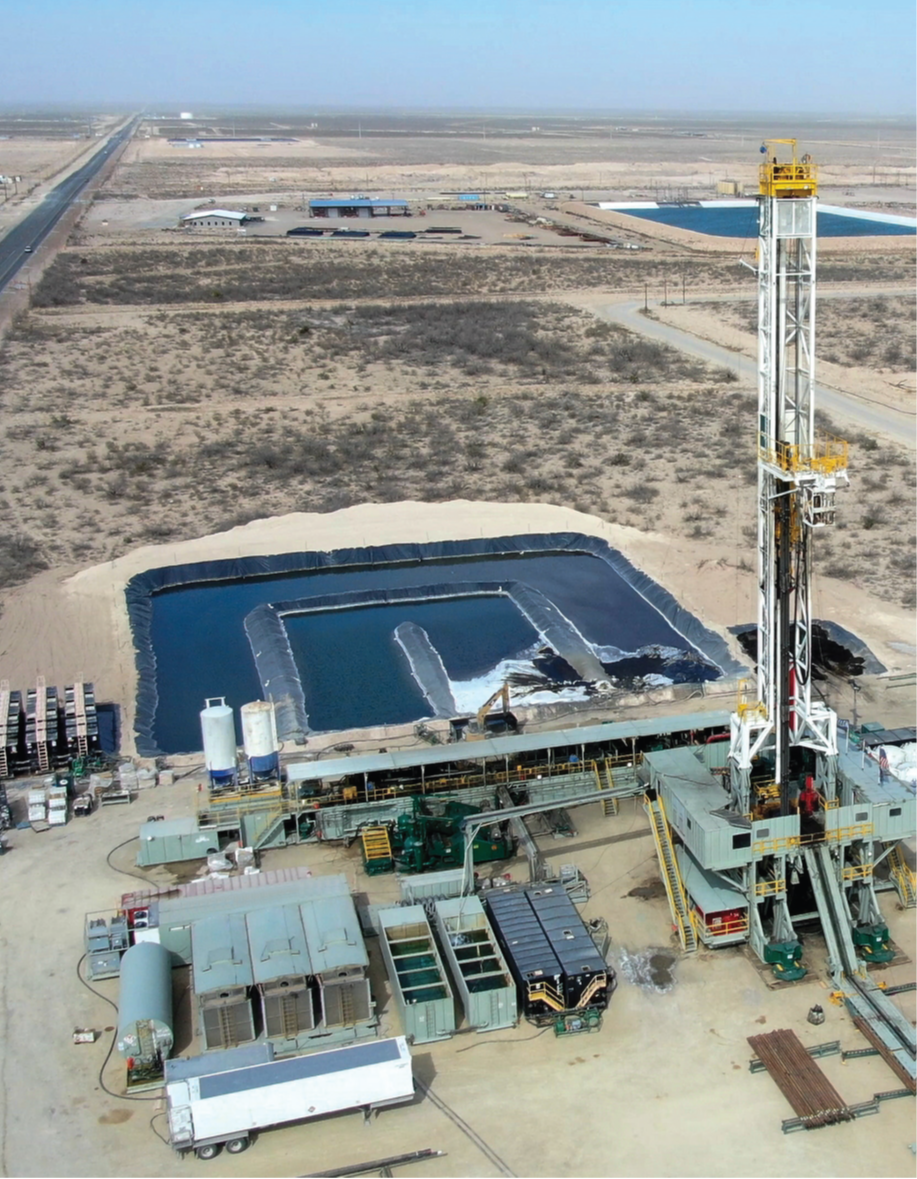
This drone view shows a rig pad in the New Mexico portion of the Permian.
On the Texas side of the Permian Basin the state government is generally supportive of its oil and gas industry, known for setting up mostly reasonable laws and environmental rules. It’s one reason the region has repeatedly set production records in recent years.
In New Mexico, about two-thirds of legislators are hostile to an industry that supplies about half of the government’s revenue. Despite the opposition, its two Permian counties are among the region’s most productive. And, as the New Mexico Oil and Gas Association (NMOGA) newsletter points out, the industry provides $13.1 billion in state and local revenue every year.
Here are some state facts from the U.S. Energy Information Administration (EIA) as of July of 2025:
- New Mexico is the nation’s second-largest crude oil-producing state, after Texas. In 2024, the state’s oil output accounted for 15 percent of total U.S. crude oil production.
- In 2024, New Mexico was the third-largest natural gas-producing state and provided 8 percent of the nation’s total natural gas gross withdrawals.
Also: If New Mexico were a nation, it would rank 14th in the world in oil production. And finally, because we have to stop somewhere, the EIA says, “Two of these [Permian] counties, Lea and Eddy in New Mexico, accounted for nearly 1.0 million b/d of U.S. production growth (52 percent) between 2020 and 2024.”



Three people who have worked in and around the state government bring deep insight into this tug-o-war. Larry Scott is a long-time oil company executive and legislator based in Hobbs. He was elected to his current seat in Hobbs’s Senate District 42 in 2024 after serving in the New Mexico House of Representatives from 2015-2024.
Stevan Pearce, a former service company owner and former U.S. Congressman from the state’s second district, on May 19th became director of the Bureau of Land Management (BLM). He also solo circumnavigated the globe in 2016 in a single-engine aircraft.
And Andrea Felix is NMOGA’s vice president of regulatory affairs.
This is the Thanks I Get

Larry Scott
One could almost hear the industry borrowing David Letterman’s quote about his mom: “I do, and do, and do for you kids, and this is the thanks I get!”
But the day of reckoning for the restrictive attitude might be on the way, said Scott. An oil business shutdown removing half the state’s revenue would create a budget crisis. Then, “Those of us that advocate for the industry, I suspect, will remain in the minority until the lights go out somewhere in Albuquerque.”
He listed three main obstacles facing the state’s oil industry.
Obstacle 1: Carbon-Free Goals
Scott’s top concern is the state’s goal for net-zero greenhouse gas emissions by 2050 and for its electricity grid generation to be 100 percent carbon free by 2045.
That sounds distant, but it’s soon enough to stop utilities from building new gas-fired generation plants because plants built now would last long past 2045 and 2050.
Therefore, “One of the consequences of that is now there is a three-year waiting period for industrial utility connections in the oil patch in southeastern Mexico. And we’ve got behind-the-meter natural gas fired generators running all over the patch as the industry tries to electrify most of its onsite operations” to avoid the grid connection backlogs.
For some in state government, even, 2045 is too far out. Steve Pearce noted that there is an “element of the political party in charge in New Mexico that says they want to curtail oil and gas completely, even by as soon as 2030.”
Obstacle 2: Methane Emission Rules
Stevan Pearce
Whether one loves or hates the methane capture rules depends at least somewhat on the size of the operator and their wells’ productivity. For big companies it can indeed pay for itself in capturing gas to sell into existing pipeline connections. “I think that methane capture is fine where it’s economic,” he said.
But for stripper wells producing too little gas to have pipeline value it’s greatly different. “The problem with capturing very, very low volumes of methane emissions is that there’s absolutely no economic recovery associated with that,” Scott pointed out.
Feds Offer Hope Here
On the federal level at least, those rules are loosening, said Pearce. He declared that the Federal government is balancing appropriate environmental protection with the fact that “we need to have jobs, we need to have energy for the country.”
For example, the BLM recently “suspended the venting and flaring rules that were put in by the Biden administration until we finish [updating] our rule.” When updated, the new rule will aim to avoid stripper well shut-ins, Pearce said.
The BLM also updated the National Environmental Policy Act (NEPA) process through an emergency order from President Trump. NEPA mandates that federal agencies evaluate the environmental impacts of major oil and gas activities—such as onshore leasing, offshore drilling on the Outer Continental Shelf, and interstate pipelines.
Under Biden administration rules NEPA usually took a year. Pearce said suspending those rules will cut lead time to 14 days, or even seven.
The agency also reduced the Biden administration’s bond from $500,000 back to its previous $25,000. “It makes low volume wells more economic,” he explained.
Rules or not, the industry’s own environmental attitude has improved greatly, Pearce assured. “I think the industry is changing and they have this corporate sense that we all want to have clean air, clean water, clean soil. We all want a sustainable future. And everybody’s working toward it, but we also have to have energy.”
Produced Water Regulations

Andrea Felix
Treatment of produced water is another issue for producers, said NMOGA’s Andrea Felix—one that offers much positive potential, and in which producers are ahead of regulations.
Calling produced water management “a core part of Permian development planning,” she noted that producers have invested heavily in systems geared toward processing and reusing it. This reduces their reliance on fresh water, a very precious commodity in the desert regions of the state.
“That investment has outpaced the regulatory framework around it,” she said, adding, “and without consistent, science-based standards for safe treatment and beneficial use, operators face a patchwork of expectations that slows adoption. Policy must match the science.”
With proper legislative and regulatory support, properly treated produced water could “ease pressure on fresh water supplies well beyond the oil field.”
Obstacle 3: Tax Money for Well Plugging Goes Elsewhere
Shutting in a producing well is extremely expensive, and there are many orphaned wells where no one takes responsibility, meaning they are an environmental and safety danger. To theoretically help with that, New Mexico has an abandoned well reclamation fund that is supported by a conservation tax imposed on the industry. However, Scott said, the money actually goes elsewhere.
Instead, “That conservation tax was utilized in our state in years past for all sorts of expenditures that were completely unrelated to the objective that the tax was originally levied.”
Fortunately, progress toward fixing that was one of two legislative victories for the oil business in the 2026 session, said Felix. “NMOGA worked constructively with legislators and other stakeholders to pass House Bill 80, the Oil and Gas Conservation Tax Act changes. HB 80 directs a larger share of existing conservation tax revenue to the Oil and Gas Reclamation Fund and supports plugging, remediation, and reclamation work.”
Can Things Change?
Politically, Scott points out that New Mexico can be divided into three distinct regions: the very liberal Rio Grande Corridor including Santa Fe, Taos, Albuquerque, and associated communities; Eastern New Mexico, where most of the oil is; and Southern New Mexico.
About two-thirds of legislators, mainly in the first region, “worship at the altar of climate change,” he said, while he contends that the state is actually responsible for little of the world’s greenhouse gas emissions.
“All that is a disconnect that I cannot fathom how it will be resolved. Because if you look at the direct and indirect revenue stream coming into the state from the petroleum industry, right now it [oil and gas] is about half of the budget. And we have nothing on the horizon that would even come close to making up that loss of revenue.”
Maybe all is not lost, because both Scott and Felix celebrated another 2026 session victory. This one was on what Scott called the “Green New Deal” front, otherwise known as Senate Bill 18, the Clear Horizons Act.
“Through a broad coalition with industries and employers across New Mexico,” said Felix, “it was defeated in the state senate.” She added, “That coalition demonstrated that broad, economy-wide emissions mandates would have consequences well beyond oil and gas and that New Mexico needs policies that are workable, measurable, and tailored to how different sectors actually operate.”
It Wasn’t Always Like This—the Blue Dogs Are Gone
Asked about the history of this opposition, Pearce said New Mexico used to be different. “When I served in the state legislature in the late ’90s, you had what they called Blue Dog Democrats. They did not always agree with Republican principles, but on things like economics, generally, and the oil and gas, the mining, the grazing, they generally voted in favor of the industry.”
But in recent years Democrats are lining up with progressives around the nation. Pearce observed, “I think this year, seven sitting Democrat congressmen and women have lost their seats to [candidates who were] more progressive, more left-leaning, more socialist.” That’s led to uncompromising stridency.
For those and other reasons, Pearce believes pushing back at the federal level is key to maintaining balance. “And that’s a struggle that I think that we at BLM are going to be in the forefront of as we continue to have common sense suggestions for keeping jobs and for keeping resources, keeping the price of gas affordable.”
So How Are Producers Succeeding?
Technology and efficiencies are driving the continued success, Scott said. Longer laterals mean more production from smaller surface areas and fewer wells. Taking advantage of the fact that many Permian plays are vertically stacked, it’s adding to the production available from each well.
“Once you get your infrastructure in place it serves much larger productive capacity than in years past,” said Scott, and Pearce agreed.
When asked about industry coping mechanisms, Felix pushed back on that term. “The industry’s growth is not a coping mechanism; it reflects exceptional geology, operating scale, and sustained productivity gains.”
It’s also about technology, including, “Better subsurface targeting, longer laterals, optimized completions, automation, electrification, and infrastructure have made New Mexico acreage highly competitive within company portfolios. Companies are not sacrificing profitability to produce here.”
She added that costs and regulatory delays do indeed have consequences, but the abundant resources and refined technology in the state have generally overcome the obstacles.
Summing the topic up in one sentence, Felix observed, “New Mexico combines a premier resource with a demanding operating environment.”

Paul Wiseman
A longtime contributor to PB Oil and Gas Magazine, Paul Wiseman is an energy industry freelance writer.
Leave a Reply