








The Permian never really needed sand. It needed fractures that stayed open, hydrocarbons that could move, and an economic reason to keep doing it. As completions become more specialized and mature wells get a second look, the question is changing: What happens when the industry stops assuming sand is the answer? Increasingly, we’re asking: What job needs to be done?
For an industry that moves millions of tons of th stuff by the seeming beach-load, oil and gas has remarkably little attachment to sand. The operator needs the fracture to stay open, hydrocarbons to move through it, and enough incremental production to justify what the completion cost. For decades, sand happened to be an extraordinarily good answer. The question now is whether it is always the answer.
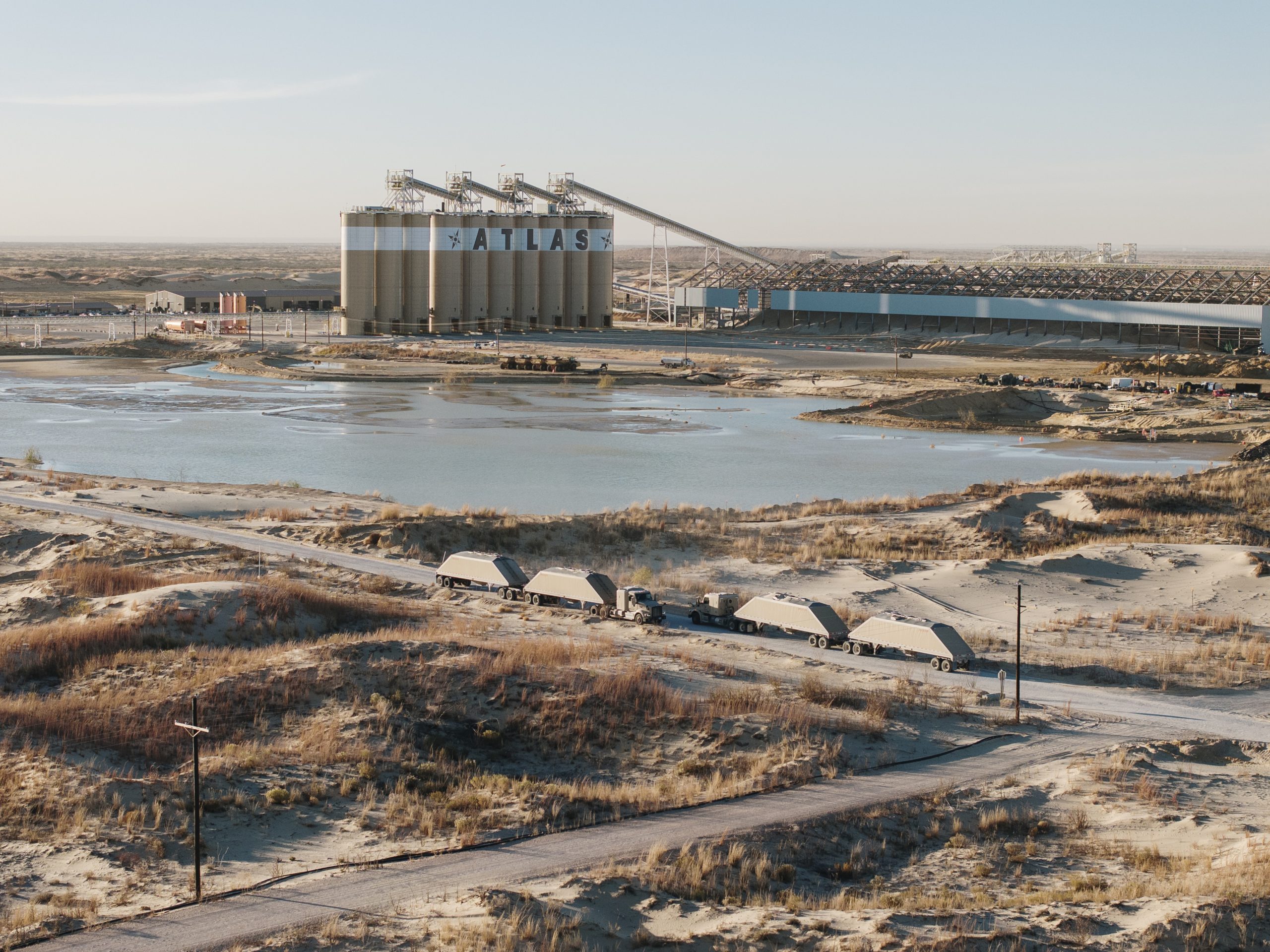
A pair of autonomous doubles pass one another in opposite directions near the Atlas Energy sand silos. The Permian sand industry has scaled new heights of innovation.
Lakshmanan Subramanian has spent roughly 10 years in the proppant business and now works with Preferred Sands in Monahans. He has watched the Permian’s relationship with sand change quickly. He explained to me how early unconventional development placed greater emphasis on qualities such as roundness, hardness, and crush resistance. Northern White sand from Wisconsin became an industry standard because it performed.
Then the Permian got very good at fracturing wells. Very good. Laterals grew. Sand intensity climbed. Volumes exploded. Logistics became an industry within the industry, and economics began winning arguments that laboratory specifications once settled.

Laksh (as his friends call him) got into the details: sand must be mined, washed, dried, and separated into specific sizes before it ever reaches a blender. Each step costs money, and someone still needs to move thousands of tons of it to the wellsite. That helps explain the shift toward sand mined close to the well, even when premium material from somewhere else might possess better physical properties. It explains wet sand, which can eliminate the expense of drying material that will eventually be mixed back into water anyway. And it helps explain why Atlas Energy Solutions built the 42-mile-long Dune Express conveyor across the Delaware Basin. When the commodity becomes cheap enough, moving it can become one of the expensive parts.
Laksh points to places such as Colorado, where comparable local sand resources are not readily available and transportation can multiply the delivered cost. The question stopped being simply, “What is the best sand?” It became, “What is the best sand once I have to pay to get it here?” That distinction helped shape the modern Permian. It may also shape what comes next.
Good Sand, Cheap Sand, Useful Sand
Calder Hendrickson, CEO at AquaSmart Enterprises, starts with a different problem. An operator can say with confidence how many pounds of proppant were pumped down a well. What becomes much harder to say is what all those pounds actually accomplished.
That gap sits near the center of modern completion design. The trucks can be counted. The boxes can be weighed. The blender concentration can be measured. The total proppant pumped is known. So far, so good. The subsurface fracture geometry is considerably less cooperative.
Operators infer a great deal from treating pressure, production behavior, and other surface measurements. More sophisticated diagnostics, including tracers, fiber optics, and high-resolution acoustic imaging, can reveal considerably more about perforation erosion, fracture behavior, and proppant distribution. But the best subsurface information can cost millions of dollars. Information has an economic threshold too. The reservoir may be hidden underground, but the invoice is sitting right there on the desk.
Hendrickson reduces the challenge to a phrase worth keeping: “We have to find ways to unlock the oil in the rock. EUR uplifting without breaking the bank.”
That may be the real future of proppant, because once the objective is framed that way, the material itself becomes secondary. The operator is not ultimately buying sand. The operator is buying conductivity, and sand is simply one way to manufacture it.
The Reservoir Doesn’t Know, or Care, What You Paid for the Sand
For years, efforts to scale spurred the industry to accept local material that was economically superior even if another sand might win on individual quality specifications. Now increased specialization may push in another direction. Instead of asking one inexpensive material to perform every job, operators can increasingly consider whether different portions of a completion require different particles, sizes, coatings, chemistries, or treatments.
ExxonMobil has developed lightweight proppant derived from petroleum coke. AquaSmart is working with coatings intended to change how proppant and frac fluids behave during placement. Other technologies employ ceramics, resins, and engineered surface treatments.
Curtis Wilie takes the idea farther. He started with Halliburton at 18, spent 41 years with Shell, retired for about six weeks, and then helped launch EcoReach. Today, after selling his company to Superior Energy Services, he continues to contribute to the field.
EcoReach uses extremely small, spherical particles derived from coal combustion products. The significance, in Wilie’s telling, is not simply that an industrial byproduct can become proppant. It is that the particles can go somewhere conventional sand cannot.
Microfractures matter. A conventional proppant grain can enter only an opening large enough to accept it. If important portions of the fracture network consist of much smaller fissures, pumping more conventional sand does not necessarily solve the problem. A smaller particle changes the geometry available to the completion, and the relevant question becomes much more specific: What exactly are we trying to hold open?
What Did We Leave Behind?
Wilie remembers when the Permian had already been declared finished. In the 1980s and 1990s, the Basin was old. The easy conclusion was that most of what could economically be recovered had already been sucked out like two kids with straws on the same milkshake. Then horizontal drilling and modern hydraulic fracturing changed the definition of “recoverable.”
The rock had not changed. The technology had.
That distinction matters because technology has breathed new life into the Permian more than once. Each generation has found another way to reach hydrocarbons the previous generation could not recover economically.
Today the Basin faces a different version of the same challenge. Prime acreage has been heavily developed. Operators are moving farther into New Mexico. The Permian contains an enormous inventory of existing wellbores, established infrastructure, and reservoirs that have already been stimulated once. So the economic question begins to change. The industry is not only asking where it should drill another well; it is increasingly asking what remains around the wells it already paid to drill.
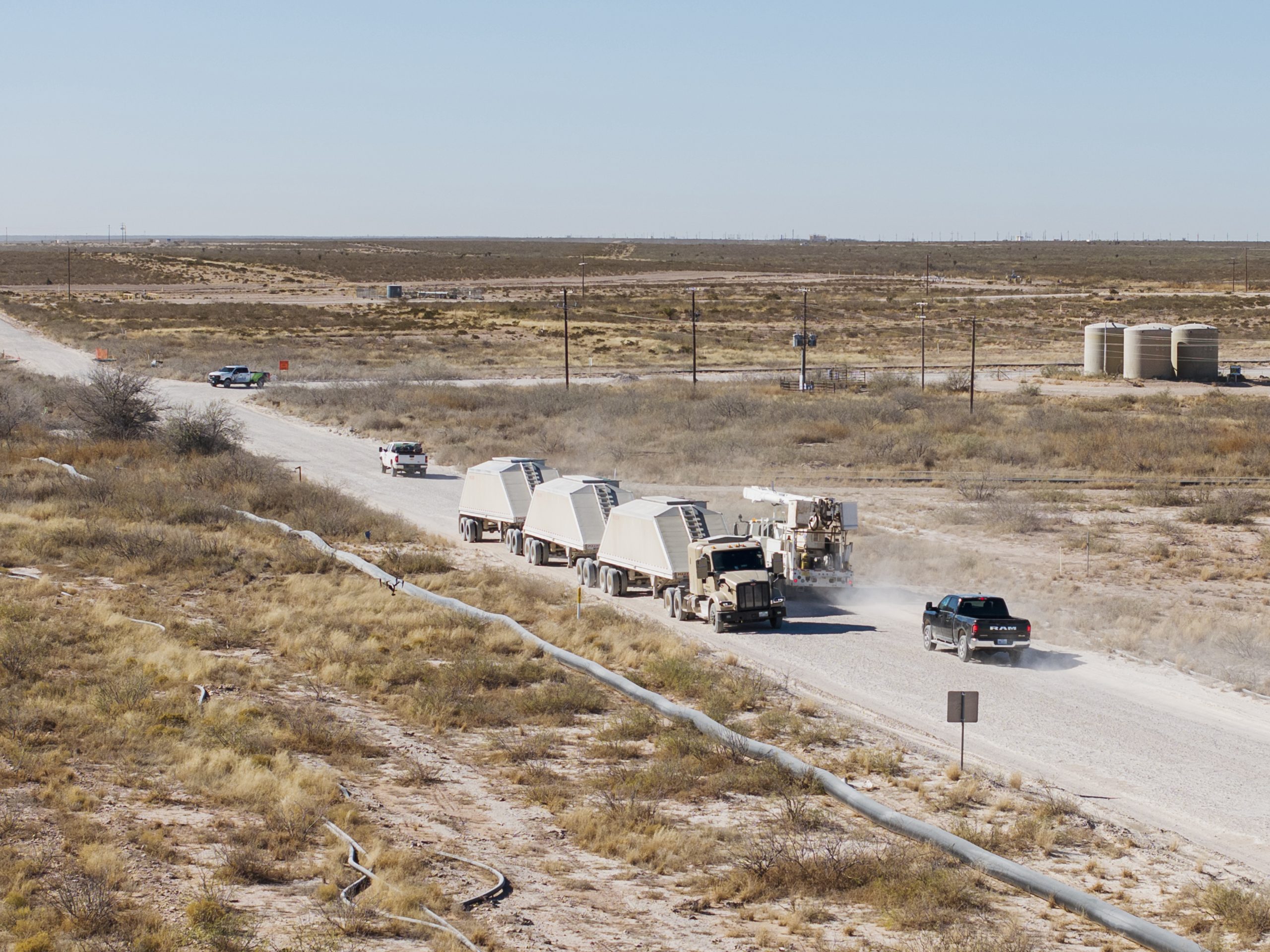
Both Wilie and Hendrickson point toward refracturing as an increasingly important part of that conversation. In conversation, independent owner/operator Reed Goodman has also made the same observation to me: in a mature producing region, returning to an existing asset can begin to compete economically with drilling and completing into a new reservoir.
That changes the proppant problem again. The material best suited for the original completion may not be the ideal material for the second intervention. A refrac may attempt to reach bypassed rock, reopen an existing fracture network, create a different fracture orientation, or access fissures that were never effectively propped the first time. The well has a history now, and its next completion has to respond to it.
Who Owns the Well, and For How Long?
Two of the three conversations produced another interesting overlap. Both Laksh and Wilie independently mentioned Fasken Oil & Ranch as an operator that tends to be unusually particular about how it develops its assets.
Hendrickson supplied a possible reason why. Different companies operate on different economic horizons. A company that expects to own and produce an asset for decades can evaluate a completion differently from one managing quarterly capital efficiency, inventory, acquisition metrics, or a future asset sale.
Hendrickson describes a related internal tension between reservoir and completions teams. Both sides have a myriad of options to achieve the same goal: make production of the asset optimal. The reservoir side may emphasize protecting the asset and maximizing recovery over time. The completions side has its own performance objectives and pressure to maximize what a treatment can accomplish. Eventually somebody higher in the organization has to decide what “optimal” means.
That decision may determine whether a more expensive proppant is extravagant or cheap. As in the old saying, “What’s the difference between hubris and confidence? The outcome,” it depends on what happens afterward. This is where cost per ton starts losing some of its usefulness as the dominant and easy measure. A more expensive particle that improves recovery may be cheaper. A cheap grain that never reaches a productive fracture area may be expensive. As my mom taught me: it’s always expensive to go cheap. A treatment that costs more today but changes the economic life of the well may look entirely different five years from now, and a company planning to own the well five years from now may calculate that value differently from one that does not.
After Sand
None of this means the Permian Basin is approaching a sand-free era. Sand remains abundant, familiar, scalable, and comparatively inexpensive. The modern Permian completion machine was built around the ability to consume astonishing quantities of it efficiently.
What is changing is the assumption that every conductivity problem begins with the same answer. The industry first chased quality. Scale then made cost and logistics dominant. Now the problem is becoming more specific: the right particle, in the right fracture, performing the right function, at a price the additional recovery can justify.
Sometimes that answer will still be ordinary local sand. Sometimes it may be coated, smaller, lighter, or manufactured from something else. The important change is that the material increasingly has to justify itself against the job.
The Permian has seen this pattern before. An old basin became young again because technology changed what counted as recoverable oil. As its unconventional wells mature, the next revolution may be less visible from the highway. It may happen inside fractures already created, around wellbores already drilled, as operators learn to recover more from rock they have already spent billions of dollars reaching.
The industry never needed sand for sand’s sake. It needed the crack to stay open, the oil to get out, and the economics to work.
What comes after sand may still be sand. But now it has to earn the job.

Christian Lombardini
Christian Lombardini, a former field operator and manager, is now a communications and content consultant for oil & gas companies and creators. You can find Christian and his The Oilfield Leader Podcast on LinkedIn.



Leave a Reply