







Click here to listen to the Audio version of this story!
In a past life I spent many years occupied full time in writing/editing/researching about the American West and its people, past and present, and I’m always surprised at how many “crossover” matters I encounter in my present life of writing/editing/researching about the Permian Basin. I’m a member of the Western Writers of America, and occasionally I’ll contribute a book review to their magazine, called Roundup. A year ago, in their April 2025 issue (find it here: westernwriters.org/roundup/back-issues) I reviewed a book titled Finding the Butterfield, about the Butterfield Overland Express stagecoach route. Now, a year later, it finally dawns on me how the Butterfield (the pre-eminent Old West stagecoach line) traversed pretty much the same country that I now cover as an oil and gas editor.
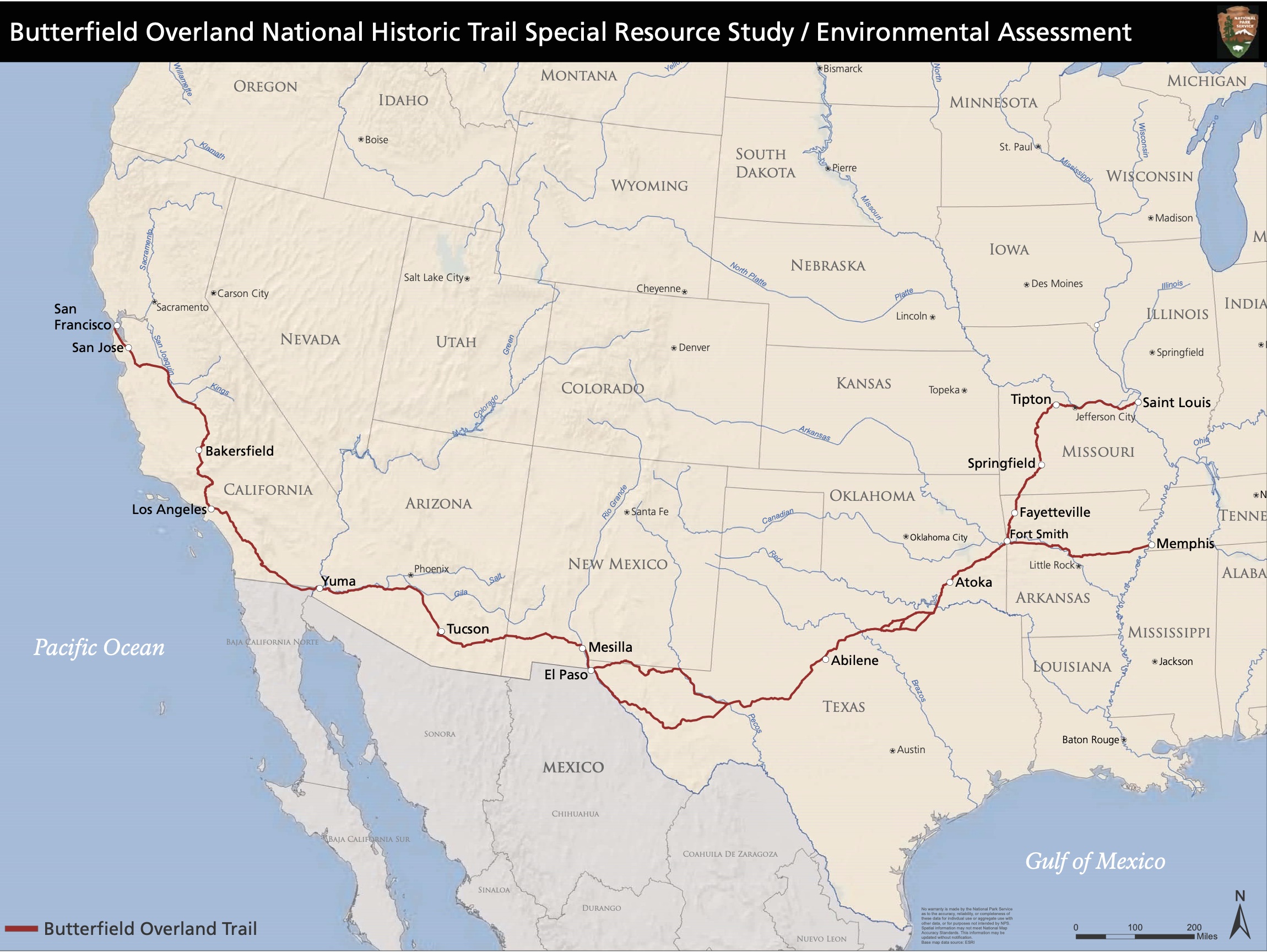
The Butterfield (see map) was created to take mail and passengers across the American West and back. It was active only three years, 1858-1861, having been interrupted by the Civil War.
The Butterfield was colorful and riproaringly Western. It’s still being studied by historians and researchers. If you trace the route on the map, going right to left (east to west) from Abilene, you see the route striking the Pecos River. In this issue, in our article on the Yates Field, we cover that part of the country. I’m not sure if the Butterfield went through modern-day Iraan (maybe a reader can tell us), but it did come close. Some accounts have the trail arriving at the Pecos at Horsehead Crossing, which is some miles upriver (northwest) from Iraan.



Wikipedia describes Horsehead Crossing as “a ford on the Pecos River in Crane County, south of Odessa. Historically, it was a major landmark… as the first reliable source of water for about 75 miles on the route from the east.”
On the first stage run westward in 1858, Waterman L. Ormsby, a newspaper reporter who was along for the ride, described their arrival at Horsehead Crossing: “Far as the eye could reach along the plain, decayed and decaying animals, the bones of cattle and sometimes of men, all told a fearful story of anguish and terrific death from the pangs of thirst.” This crossing was also a favorite ambush point for the Comanche Indians.
Returning to our map, we see that the route followed the Pecos northwest, until it struck a point near the modern-day New Mexico border with Texas, whereupon the trail departed the Pecos River and took a more westerly route. In other words, the Butterfield Trail entered the Permian Basin around its eastern fringe and stayed within its boundaries as it ventured through the heart of what is now the Delaware Basin and departed the Permian on its westernmost fringe. That’s a pretty close connection with our oilfield world. I hope to revisit this topic in a future issue.
Jesse Mullins, Editor
Jesse Mullins is editor of Permian Basin Oil and Gas Magazine.
Jesse, jolly good piece. More, more, more! — Mark S. McDonald, Midland