







“It’s sunny and hot” in the Permian Basin, said Josh Robison, renewables and storage asset leader in Chevron New Energies. “I actually lived in Midland/Odessa for a period of time, so I can say that.”
He was explaining why the company has two solar assets in operation in the Permian today, with two more expected to come online by December 2026. These are/will be connected to significant load aggregations, meaning oilfield operations drawing a large load.
Occidental Petroleum also has a major solar installation in the Permian, at Goldsmith, powering an enhanced oil recovery (EOR) operation.
And while solar is the current leader in renewables, Thomas Telegades, through his PwrCor company, has big plans for using a more-efficient form of geothermal energy capture to grab waste heat from produced water and oil. Its purpose will be to also provide low-carbon power onsite.
Chevron Catches Some Rays at Hayhurst



The two currently operating Chevron Permian solar facilities are at the Hayhurst site, straddling the Texas/New Mexico border south of Carlsbad, New Mexico. On the New Mexico side, in Eddy County, the company has a 20-megawatt (MW) facility and, on the Texas side, in Culberson County, a bit larger one, at 25 MW.
The New Mexico operation came online in 2023 and the Texas site in 2024, Robison said. A 2023 Chevron press release reported that the solar facility was the first in the company’s renewable power agreement with Algonquin Power and Utilities Corp. The field powers a Chevron-owned natural gas compressor station.
The press release shared the thinking behind the solar field’s installation.
“‘The solar field is supplying a pretty significant portion of the power needs during daylight hours. The power costs will also be less than what we’re paying for energy from the grid,’ said Bobby Hulett, Chevron’s general manager of operations for its Mid-Continent Business Unit.” The “pretty significant portion” is listed at 70 percent.
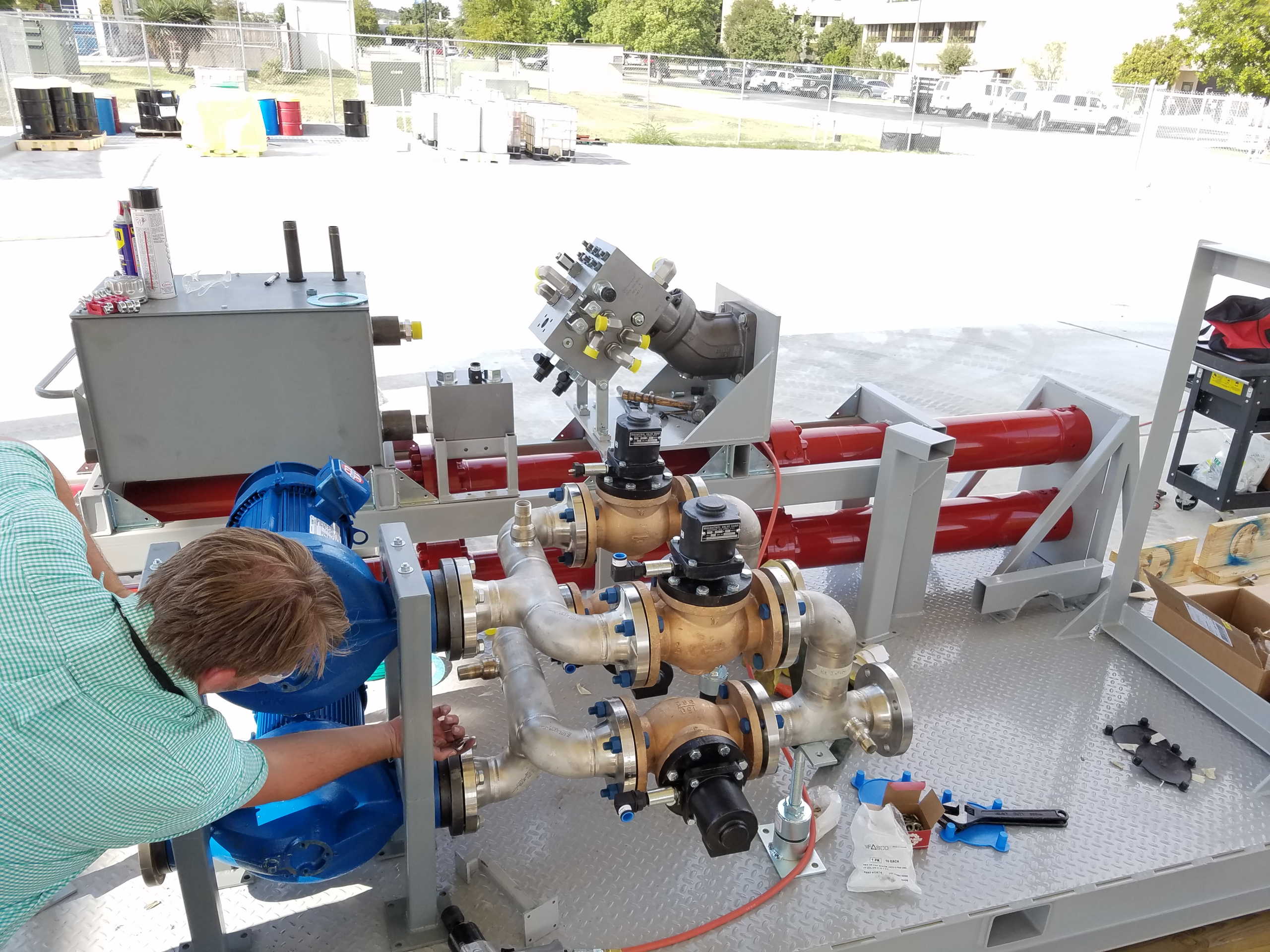
A geothermal system under development by Pwrcor employs CO2 as a working fluid. the system taps waste heat on an oil and gas site as its thermal source.
Two More On the Way
Robison listed two more solar projects expected to begin operations by the end of 2026.
One is the 18 MW Greater Bryant G, south of Midland. The other, called Delaware Ranch, is a 36 MW facility close to the others at the Hayhurst location.
All four sites are located adjacent to Chevron oilfields and supply power to onsite loads behind the meter first, with the three Texas facilities also connected to the grid. The solar facilities leverage existing infrastructure and are connected at Chevron-owned substations.
Decisions, Decisions
Using Delaware Ranch as an example, Robison discussed how the company decides where to locate its solar farms.
Delaware Ranch is near a significant aggregate load, including a natural gas compressor station. Another factor is, “What is the duration of that load?” In other words, will the demand continue for enough years to make the investment pay off?
Another key is the availability of nearby land for placing acres of solar panels. As noted in the opening of the story, the Permian Basin offers a lot of solar energy along with its abundant oil and gas. Co-locating solar with the demand center minimizes transmission costs.
While solar panels, of course, only produce power in the daytime, Robison pointed out that that time frame, especially in summer, is when the ERCOT grid is under the greatest strain—and these solar facilities are helping reduce that.
“That production of the behind the meter asset is supporting our assets during that period of time and reducing the strain on the grid or the draw from the grid at that time,” he said. The other question is, “How do we make sure that doesn’t have any detrimental effects to our reliability or things of that nature?” The Texas facilities have satisfied all those questions.
Occidental’s Solar Array
Like Chevron, Oxy is also interested mainly in lower costs and lower emissions, said a company spokesperson responding to emailed questions. Its solar plant powers an EOR field.
“The Goldsmith solar plant expands on Oxy’s efforts to economically lower GHG intensity by using emissions-free power sources in our operations where feasible,” the person said.
Oxy also claims primacy in the category. “The 120-acre field was the first large scale solar facility of its kind that directly powers oil and gas operations in Texas. It features 174,000 PV panels with a total capacity of 16 megawatts, which powers the entire Goldsmith EOR field and often supplies surplus electricity to the grid.”
After installing the panels, they did some further GHG reduction by reseeding the area around the panels with native plants, “which Oxy continues to monitor and manage.”
Here are the power and emissions numbers they reported: “In 2024, the facility generated approximately 40,000 MWh of electricity, reducing the Goldsmith EOR field’s emissions by nearly 16,000 MT of CO2 compared to electricity purchased from the grid.”
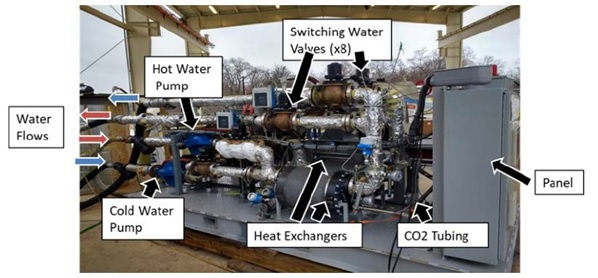
This annotated image gives callouts of the major components of Pwrcor’s new system. Compare this image with the photo on the preceding page for a breakdown of the skid unit’s hardware.
PwrCor: Why Waste All That Heat?

A recent PBOG story discussed how oil and gas operators and service companies are adding geothermal operations to their portfolios. They’re doing that mostly outside of oil producing regions, opting for formations with higher temperatures that are more easily harvested than those available in Permian production.
Thomas Telegades notes that, with new technology, operators may be able to use what has been considered waste energy from several sources to power their onsite equipment.
“In an oilfield setting,” he said, “that heat can come from hot co-produced fluids, from compressor and engine exhaust or cooling systems, or from other process streams that normally must be cooled and discharged.”
He continued, “The objective is not to replace the well’s primary production system; it is to recover useful power from a heat stream that is otherwise largely wasted.”
How Would This Be Different?
Most traditional low-temperature geothermal systems stop at around 250°F, Telegades said. PwrCor’s has been tested down to 140°F.
“Most geothermal power systems that operate at modest temperatures use an Organic Rankine Cycle, or ORC. Those systems circulate an organic working fluid, boil it with geothermal heat, expand the vapor through a turbine, and then condense it back to liquid,” he explained.
PwrCor instead relies on CO₂ as the working fluid. He explained, “…the PwrCor cycle is designed to avoid the energy losses associated with repeatedly changing the working fluid from liquid to gas and back again.” That would make it economically feasible at lower input temperatures.
Telegades said that the CO₂ option lets the system produce 1.5 to 3 times the energy of a traditional ORC operation, although he stressed that the exact amount is site specific, depending on the amount of source of the heat generated.
Free as the Breeze
Like wind and solar, there is no fuel cost associated with geothermal. Once the installation is done, daily operating costs are close to zero, and so are GHG emissions. These two factors are among the main reasons operators are looking at renewables for onsite power.

Chevron’s Hayhurst Facilities are the first in the company’s renewable power agreement with Algonquin Power Utilities Corp.
Your Results May Vary
How much is saved by geothermal depends on several factors, he said. “The savings are likely to be most compelling where the alternative electricity is diesel-fired, constrained, expensive, or subject to high demand charges. Where inexpensive and reliable grid power is available, the economics must be evaluated on a site-by-site basis.
PwrCor’s published materials project potential demand-site generation costs below $0.04/kWh and paybacks of roughly two years under favorable commercial conditions, but those are projections, not a guarantee for every well or facility.”
How much power the system can produce varies widely. Pointing out that there is no such thing as a “typical Permian well,” Telegades said the exact geothermal output depends on five variables.
- Produced-water flow rate.
- Produced-fluid temperature at the heat exchanger.
- How much the fluid can be cooled before it goes to the next process step or disposal.
- The well’s operating uptime.
- The electrical demand of the site, including ESPs, artificial lift, separation, water handling, compression, and other equipment.
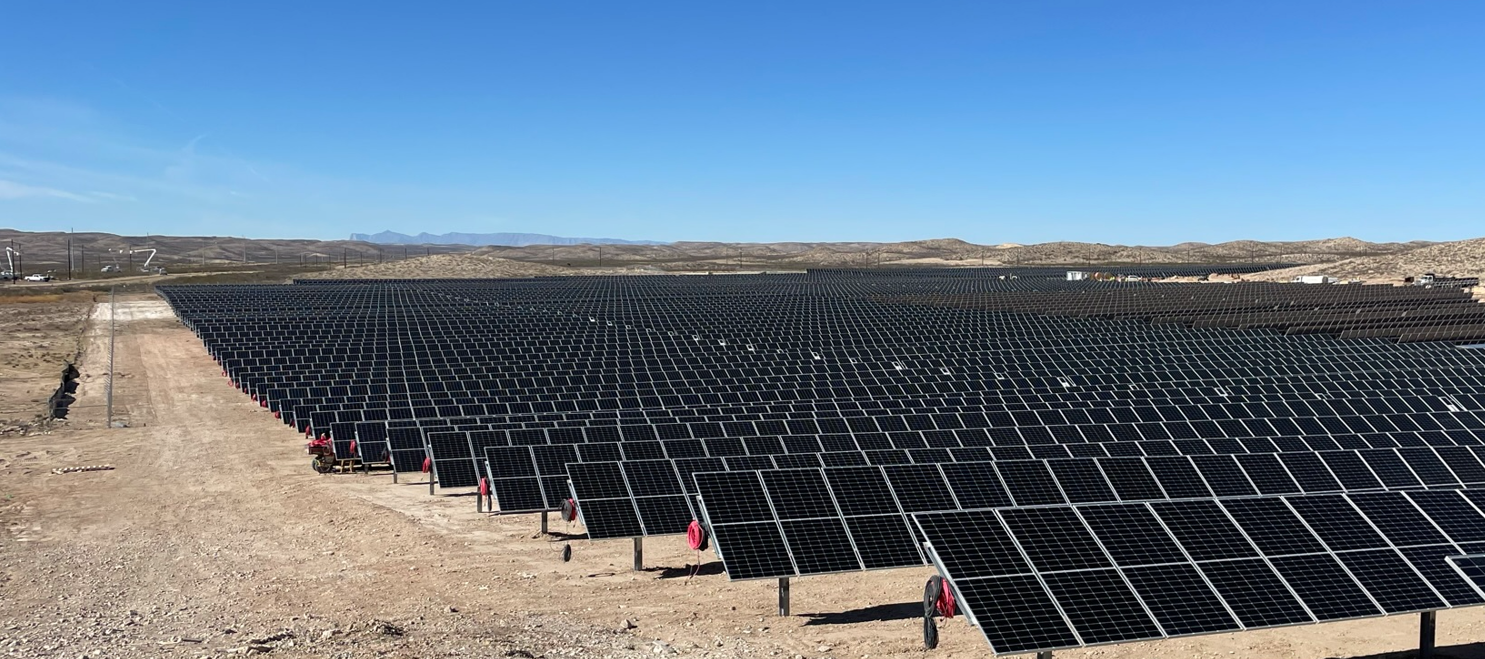
Shown here is the Texas portion of Chevron’s Hayhurst solar sites. (The two solar farms straddle the Texas/New Mexico one south of Carlsbad.) The New Mexico project, generating 20 megawatts, lies in Eddy County. The field shown here generates 25 megawatts and lies in Culberson County. The solar facilities power a Chevron-owned natural gas compressor station.
Testing, Testing
While PwrCor’s system has not yet been commercially deployed, Telegades says a predecessor of the system has shown that using CO₂ can work.
The previous system operated in a multi well oilfield setting to provide “direct mechanical lift for producing wells. The system used a closed CO₂-based thermal-hydraulic engine: a hot-water loop heated the CO₂ working fluid, a cooling loop contracted it, and that repeating expansion-and-contraction cycle drove a piston connected to the well’s rod string. In other words, heat was converted directly into the mechanical motion required to pump the wells,” he said.
Instead of harvesting heat from produced fluids, that one used gas-fired hot water, so it was neither fuel-free nor emissions-free, and it directly ran equipment rather than generating electricity. But Telegades believes it validated the use of CO₂ as an option for low-cost power conversion.
Permian as Power Central
As noted by Chevron’s Josh Robison, the Permian Basin is the source of multiple types of power. Oil and gas have long been mainstays, but it’s sunny almost every day, and windy very often. And newer geothermal systems could be on the verge of adding another underground power source to the Basin’s arsenal.
And as renewables power more and more oil and gas operations, the varying energy sources are increasingly working together.
Energetically, you might say.

Paul Wiseman
Paul Wiseman is a longtime writer in the energy industry.




Leave a Reply